


Style as Evidence: Case studies in aesthetic evolution and psychological alignment, interpreted through the Style Alignment Chart.
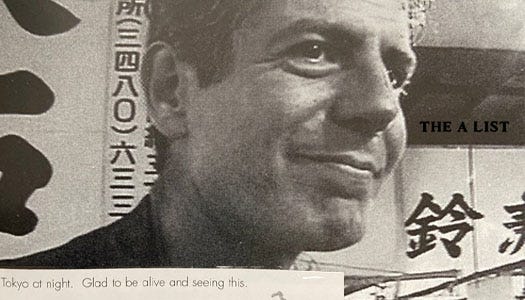
Your style is a self-fulfilling prophecy. What you wear shapes how you behave, how the world responds, and who you eventually believe yourself to be.
Therefore, style is not metaphorical. It’s behavioral.
Reading Kitchen Confidential felt like when your vision snaps.
All of the sudden, my perspective changed in an instant. Here I was, sitting in a studio that was barely big enough for my bed, with a book I thought I would find mildly interesting, at best.
I blinked and it was 2am, my eyes red, the pages blurry, my fingers feverishly flipping the pages like how a fiend looks for the loosey thats always right behind his ear. I wanted to stay up all night, I wanted learn to cook sauce from scratch. Back then, my entire cooking repertoire could be summarized by a walk down 6th Ave to Trader Joe’s, and my tried and true, the defrost button. I remember sheepishly looking down into my bowl of veggie fried rice and realizing that I was, all the sudden, quite embarrassed at my ‘abilities’ and, maybe even at my preferences? My standards? What if he came through the door right now and saw that I had pre-mined garlic in my fridge? I threw it away on the spot.
I didn’t know much about him then. I wasn’t following his shows. I barely understood why he was famous. But I do remember opening my half-dead laptop and typing into Google:
Anthony Bourdain, style.
Because whatever this energy was, sharp, human, unfiltered, I wanted to know what it looked like.
“Garlic is divine. Avoid at all costs that vile spew you see rotting in oil in screwtop jars. Too lazy to peel fresh? You don’t deserve to eat garlic.”
Kitchen Confidential
The Familiar
(Unconscious + Neutral)
Presentation as belonging.
In the early years, Anthony Bourdain dressed the way every serious kitchen demanded: quickly and consistently. Chef’s coat, checkered pants, black clogs.
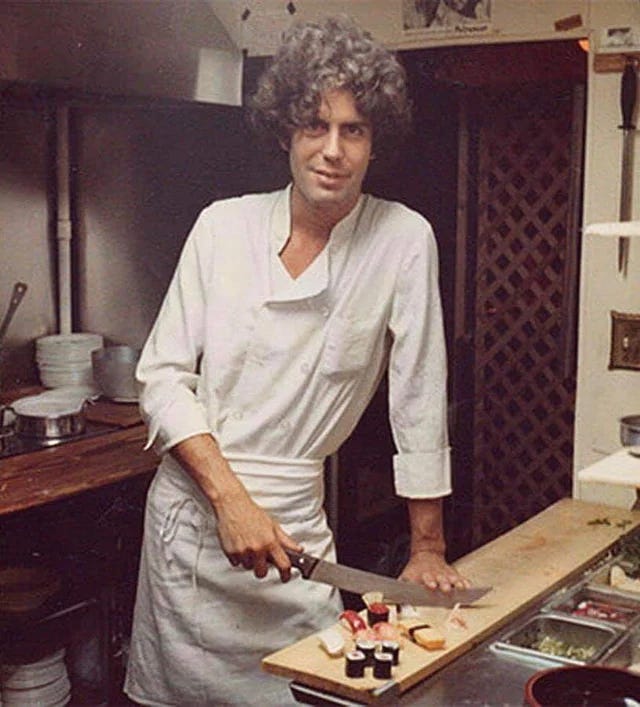
He once said that kitchens attract “misfits and pirates,” and as someone whose worked in kitchens and tending bar, that was certainly reflected in the way he wore his whites. Sleeves pushed up a little higher than necessary, a cheeky band tee peeking from the collar, the cigarette tucked behind his ear. His knives were very clearly the only possessions he treated with love: polished to a shine each night, carried the way most men would posture their expensive watches.
When Kitchen Confidential came out, he looked like a line cook who’d accidentally written a bestseller. Which, to be fair, was kind of true, though he had been elevated a little past the line by then. Press photos show him in the same beaten leather jacket, the same jeans, the same boots he had worn the night before. The way he looked was almost with and without ego; he made the ordinary look dangerous, and we loved him for it.
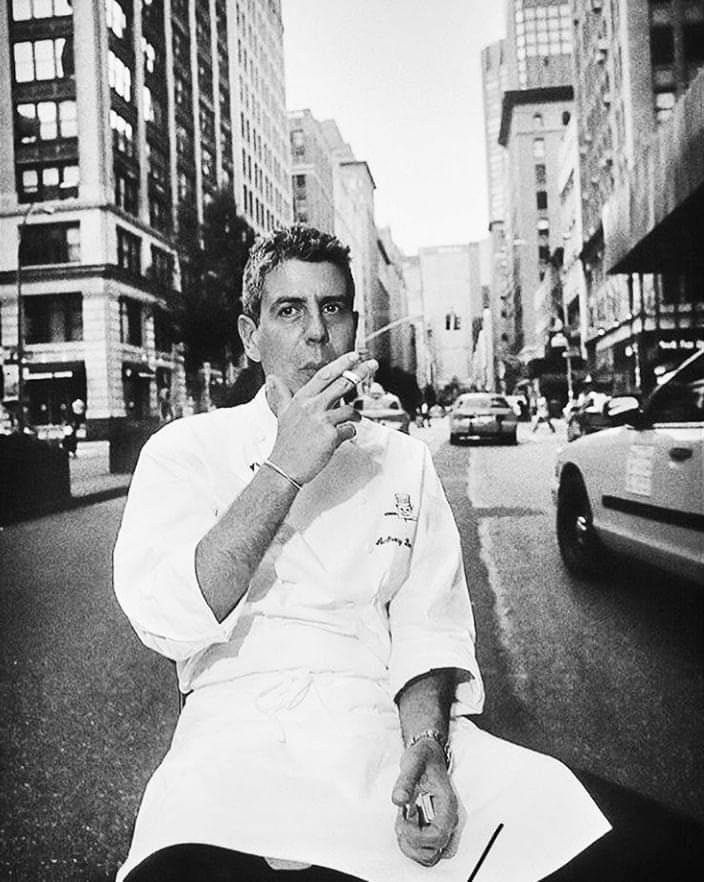
The Seeker
(Deliberate + Neutral)
Presentation as experiment
The Seeker appears when someone begins using their appearance to understand who they’re becoming, and thats exactly what happened to Bourdain the moment fame yanked him out of the kitchen and into the rest of the world.
In the No Reservations era, he didnt change overnight, but he was forced to look at himself in a new way. He had spent decades in a uniform, never needing to ask who he was beyond it. But the moment Kitchen Confidential made him visible, he had to reconcile two identities: the man he had been, and the man the world suddenly saw.
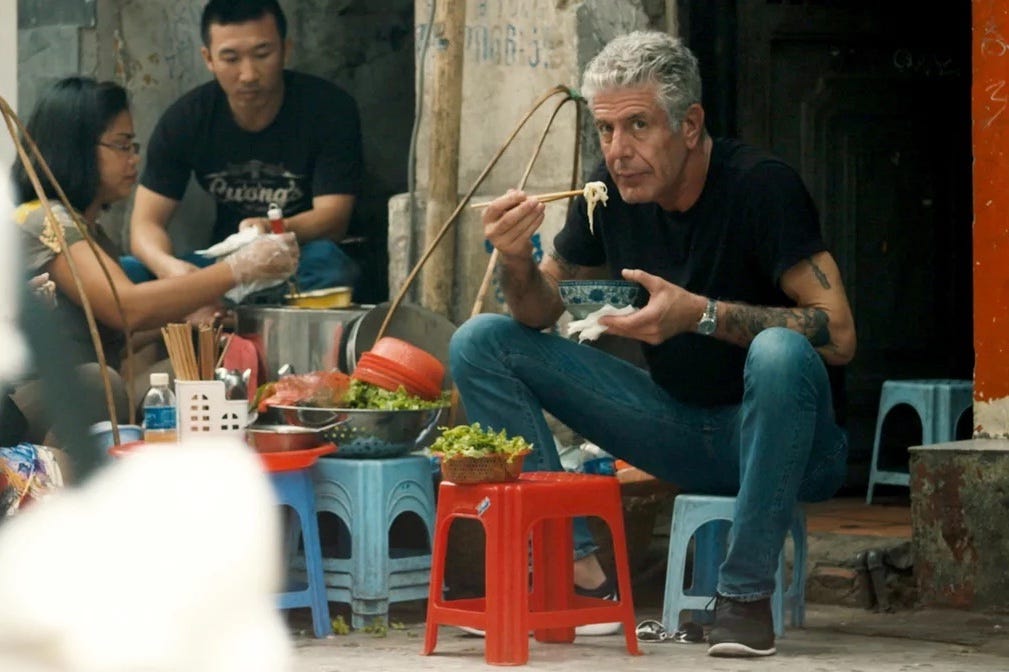
His wardrobe transformed from something he shared with a collective to something that belonged just to him. This is when his style settled into the look most people associate with him: dark denim, fitted shirts, leather jackets that had texture and mileage, combat boots perfect for Tokyo and back-alley kitchens. Producers for No Reservations and later Parts Unknown often offered wardrobe help, even full styling support, and he turned it down every time. It was the one part of his life he could control while everything else was accelerating.
Eventually, he entered fatherhood and a more stable home life. His wardrobe softened into navy sweaters, sneakers he wouldn’t have worn before, lighter fabrics. Small choices, signals of a mental shift.
Experimentation doesn’t always look eccentric. Sometimes it looks like someone holding steady.
The Ghost
(Disengaged + Withdrawn)
Presentation as survival.
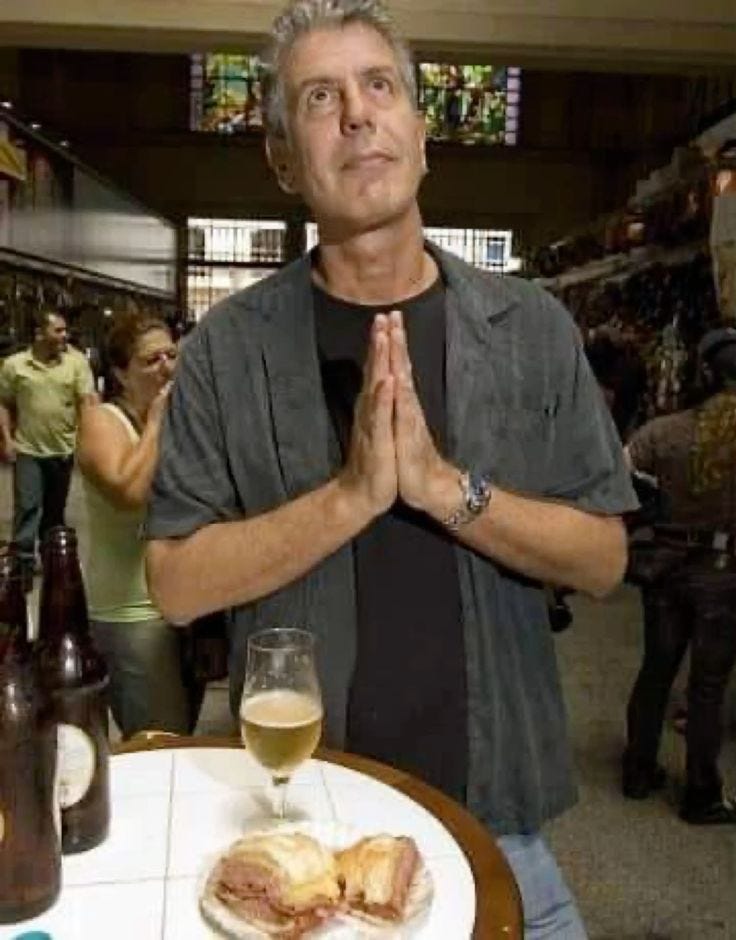
What haunts me isn’t what he wore at the end, but how looking back its so obvious that he was fading in plain sight.
In the later years of Parts Unknown, Bourdain’s wardrobe narrowed to a few pieces, and the the leather jackets and fitted shirts lost the rock-and-roll charm and wit that defined his Seeker years. As his life became more demanding and emotionally unstable, he shed anything that required additional care. Accessories disappeared. Layers disappeared. Color disappeared. Crew reports describe him as quiet, flat, unusually withdrawn between takes. The visual evidence matches the clinical profile: diminishing affect, constricted expression, reduced self-care. The clothes weren’t style anymore. They were function at its most basic level.
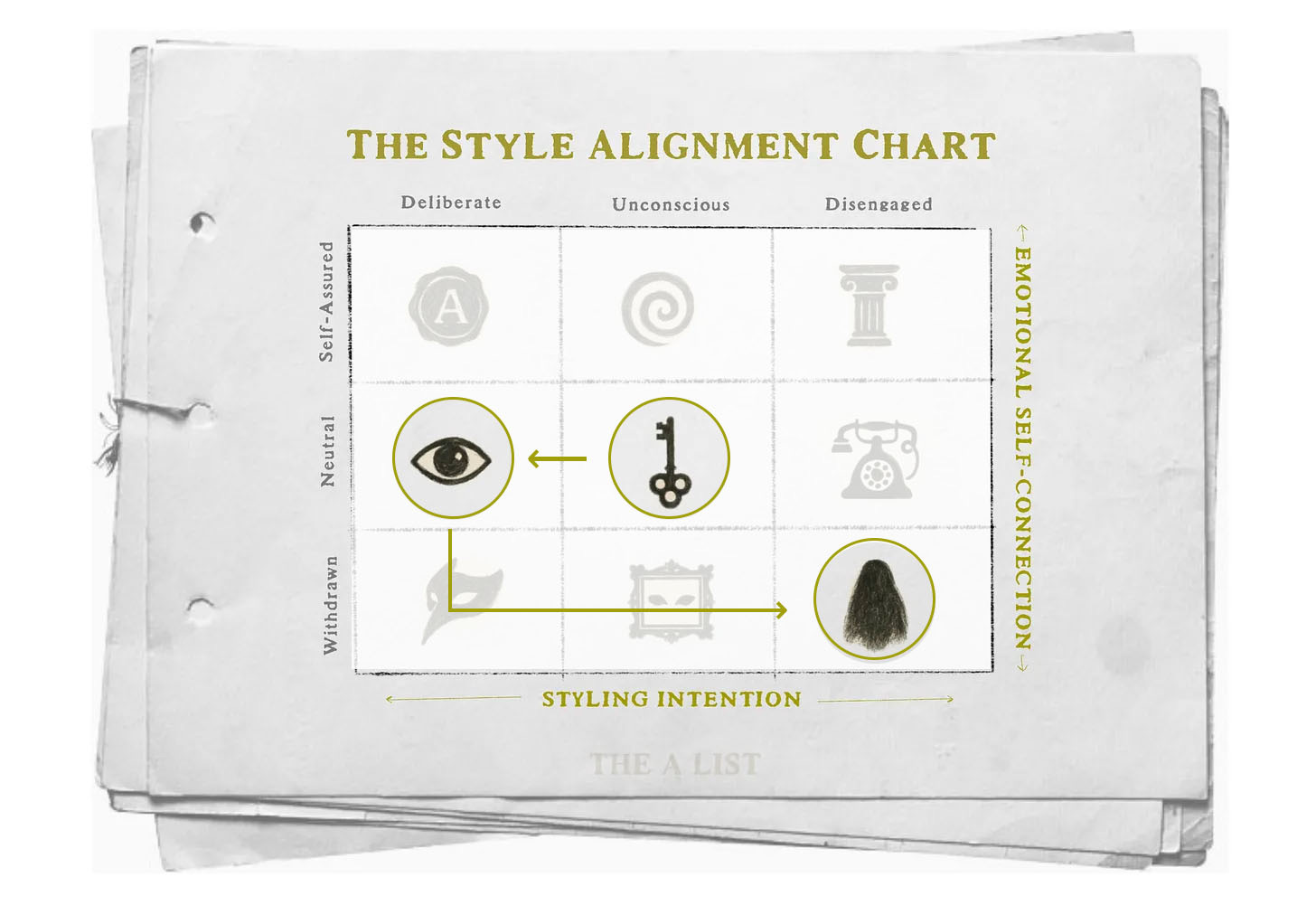
The Ghost is Disengaged and Withdrawn.
This alignment forms when someone no longer uses appearance as to express. Clothing becomes the simplest version of itself because the person wearing it is conserving every resource they have. For Bourdain, this wasn’t a loss of taste. It was a loss of capacity. The shrinking wardrobe, the reduction of color, the reliance on sameness, these were clinical signals long before they became cultural tragedy.


The Transformation
The Familiar → The Seeker → The Ghost
His style wasn’t performance or persona, it was evidence. And when you read it through the Alignment Chart, the pattern becomes unmistakable: the man he was, the man he explored, and the man he struggled to remain.
Style does not hide the truth. It reveals it. Sometimes long before the person wearing it can say it out loud.
We talk a lot about authenticity, but Anthony Bourdain actually lived it.
What I’ve always admired is how little he relied on anything artificial. No entourage, no rehearsed charm, no pretense. He said what he said and wrote what he did, with no apology and no pandering. He followed his curiosity with a Cheshire cat grin until it led him somewhere worth sitting down. He spoke with the kind of honesty that makes you braver without making you harder.
He always ate the food offered to him, even when he disliked it, because he believed refusing a meal was refusing a person. He once spent hours helping a young line cook fix his knife grip because no one had ever shown the kid how to hold a blade without hurting himself. He kept postcards from strangers tucked into his travel bags. He could be sharp, impatient, and exacting, but he was never detached from the people around him. He cared about the underdog, the overlooked, the ignored. He cared about cooks, taxi drivers, the grandmothers with one good recipe, and anyone who was trying to give life a good, honest go.
It isn’t the fame or the shows or even the writing. It’s the humanity. The sense that he cared more about understanding the world than convincing it to understand him.
That’s the kind of style I aspire to, to look like the life I’ve lived.
“Or do we want to eat without fear, tearing into the local stew, the humble taqueria’s mystery meat, the sincerely-offered gift of a lightly grilled fish head? I know what I want. I want it all. I want to try everything once.”
With great personal aesthetic,
Alexandra Diana, The A List
If you or anyone you know is struggling with suicidal thoughts, help is available.
In the United States, you can call or text 988 for the Suicide & Crisis Lifeline.
You are valuable and your life is worth living.


I shed a tear at you saying that you want your style to reflect the life you lived. Because same. It’s so beautiful. And Anthony will forever be the rockstar of my life. The reason why I even dared to be a chef once in my life was because of him.
this is incredible