

There are 9 reasons you don't look like yourself
Introducing The 9 Archetypes of Appearance & Identity™

You’re standing in front of your closet, and it’s completely full.
You’re frustrated, overwhelmed, staring at things you bought, things you kept, things you meant to return, and some things you can’t even explain.
As you’re standing there, you have the familiar, sharp paralysis of someone who has too much, but somehow not enough, and you think: How is it possible that I have absolutely nothing to wear?
…but that’s not quite what you mean, is it?
You have millions of things, it’s just that none of them work. None of them are you, none of them feel right. You’ve bought everything you’re supposed to have and yet somehow you’ve ended up in the exact same place you were before, and it’s infuriating.
The fashion industry has declared your wardrobe is a problem, and they’ve been saying it for decades. Each year there seems to be a new magic wand: The capsule wardrobe, body type guides, your seasonal color analysis, investment dressing, the clean girl era, creating your Outfit Formula, on and on and on, each one with the same promise: Follow these rules, and you will never have this problem again. Follow these rules, and you will finally look like yourself. And so you do. But you don’t. And you have no idea why.
But I do.
You, my friend, do not have a style problem. You have a behavioral one.
You don’t know who you are, you know who you are supposed to be. And that gap creates a world of pain.
Every morning, whether you know it or not,
you are making a decision about your identity. The freakish thing is that there are only two ways to go: either you are in control, or something is controlling you. That ‘something else’ has several faces: The status-quo, your judgmental boss, what your friends are wearing, the version of yourself you were three years ago, what your parents would say. All of these voices in our head make us afraid to stand out, afraid to be embarrassed. We habitually make ourselves smaller every day, and then we wonder why deciding what to wear is exhausting.
When you search for answers, all you’re told is how to look like someone else. You’re given other people’s capsule wardrobes, other people’s outfit formulas, other people’s aesthetics, and you feel like a failure when it still doesn’t work.
It doesn’t work because it was never made for you. It was made for the idea of you. The category you represent. For your body type, your color palette, your Pinterest board. Nothing was made for the actual, specific, singular person standing in front of the mirror at 7am trying to figure out who they are today.
Your personal style is not your identity. It is the mechanism through which identity is formed. Appearance becomes behavior. Behavior becomes self. This loop has been running your entire life, whether you knew it or not. If you don’t understand what it’s currently building, then you are not in control of it. Someone else is writing your prophecy.
I made something for that person.
It’s called The 9 Archetypes of Appearance & Identity™ — the first framework that doesn’t tell you what to wear, but tells you what your wardrobe has been doing to you.
The 9 tracks two things: How deliberately you engage with your appearance, and how much of who you actually are makes it out the door. Where those cross, you’ll land on one of nine archetypes. They’re fluid, movable, context-dependent. You may have been three of them in the last five years. And knowing where you are is the only way to understand where you’re going.
Before you read The 9, take the quiz first. It’s 3 minutes. Then come back.
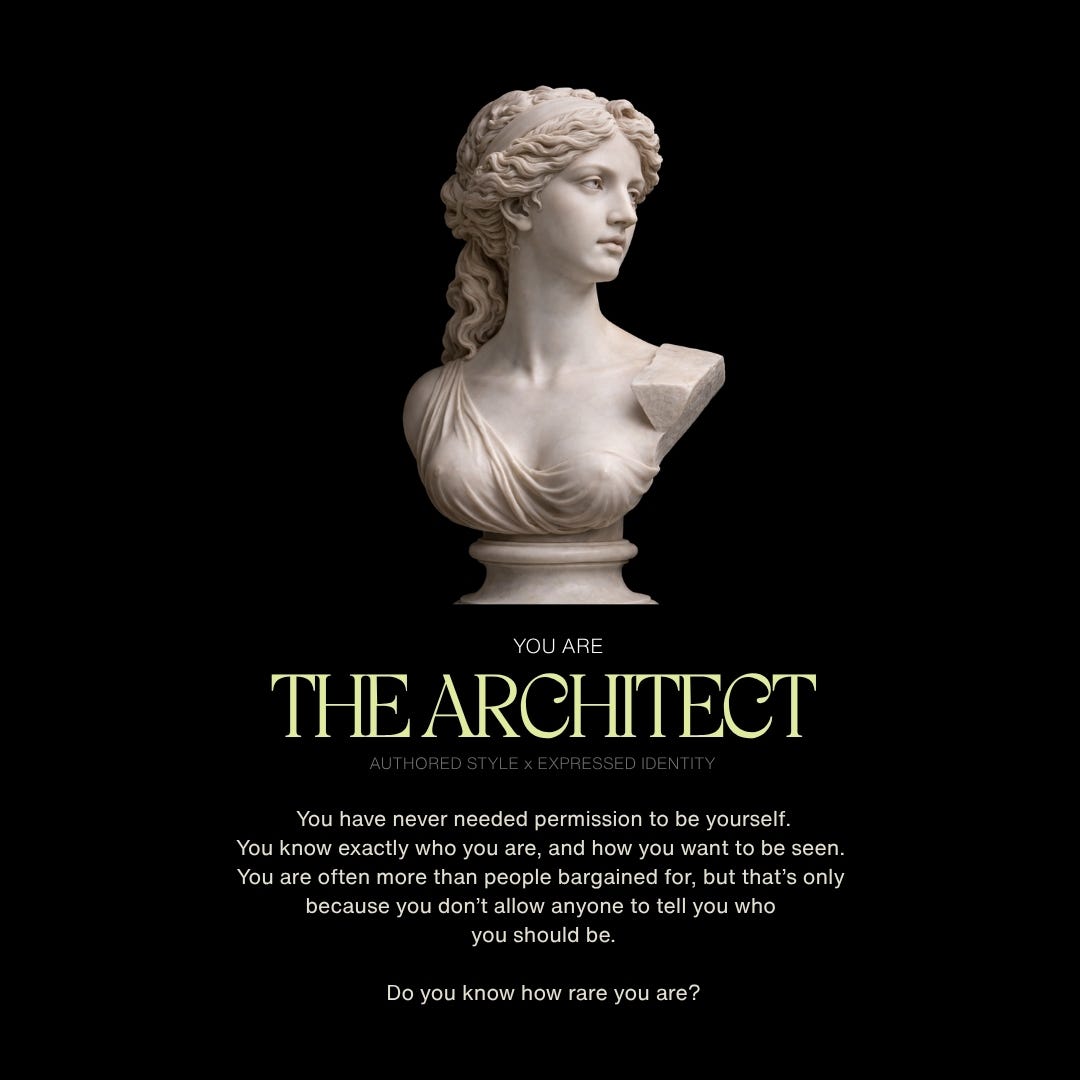
The Architect
Authored Style × Expressed Identity
Someone notices a specific piece, an earring, a pin, something small and deliberate, and the Architect smiles. The smile of someone who has been understood, like you discovered the password to a hidden world, you saw what others missed.
Every piece means something. Nothing is chosen at random, nothing is leftover from an earlier version of themselves, nothing was kept out of laziness. Their outfit is a private text written in a vocabulary entirely their own. Often believed to be high-maintenance, The Architect has no interest the status-quo. They dress exactly as they intend to regardless of where they’re going, or who they’re seeing. No two Architects share a language, and that is the point, the aesthetic is irrelevant. The authorship is everything.
The Architect does not dress for your approval. They dress the way most people only dream of living: entirely on their own terms.
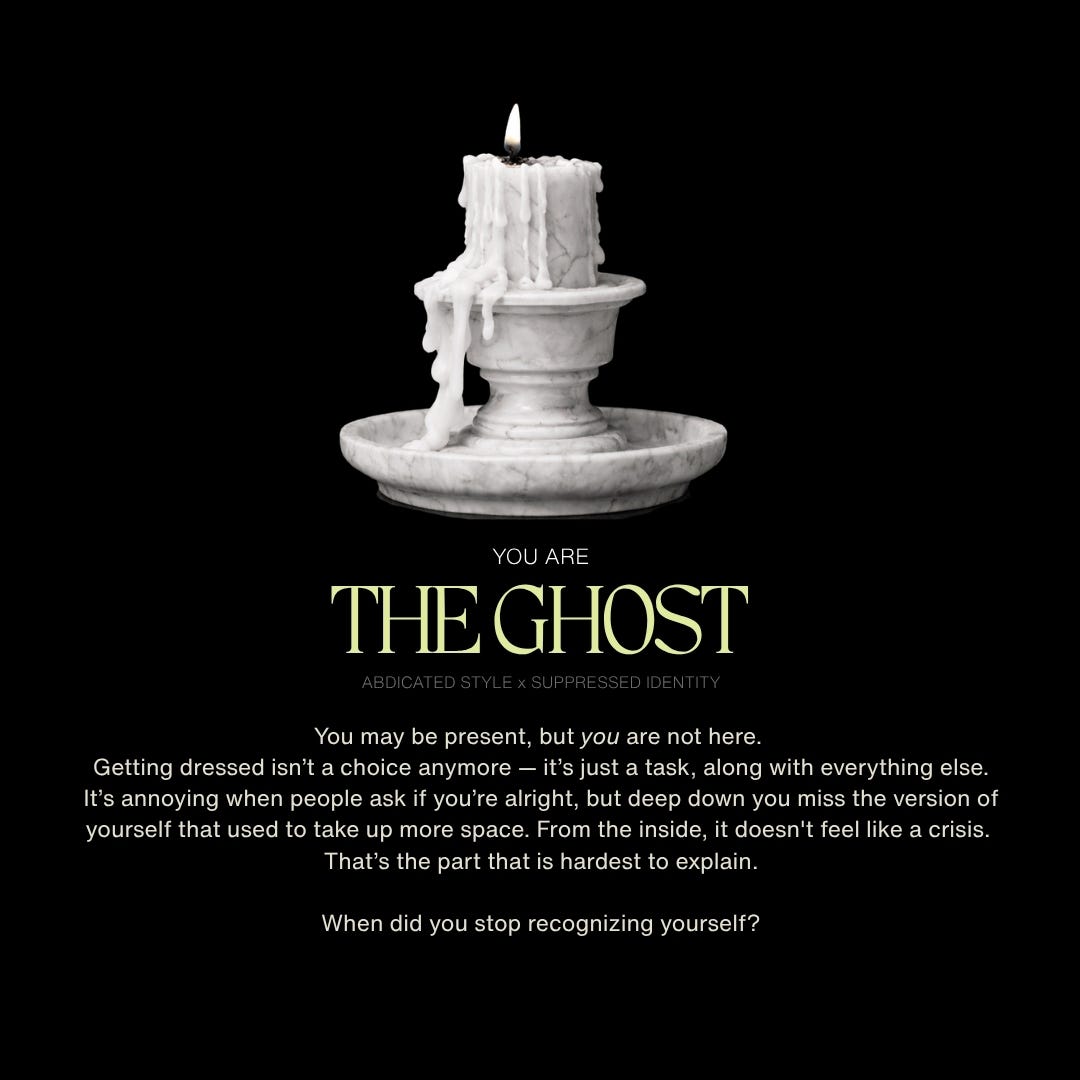
The Ghost
Abdicated Style × Suppressed Identity
If you look at photographs from a few years ago, there’s someone there who looks more like themselves than the person you see now. The Ghost is present. They are here. They are functioning. And yet something underneath the surface has hollowed, so gradually and so quietly that most days they don’t notice, and on the days they do, they put the feeling away before it becomes something they have to address.
Getting dressed is a task that gets completed, just like everything else. If someone asks if they’re okay, there’s a flash of something— irritation, sadness, or the perhaps the exhaustion of being seen when you’ve been working very hard to be invisible. They resent the question because of what answering it honestly would cost: energy they no longer have.
There is no judgment here. The Ghost is surviving something. And surviving, for now, is enough.
If this one felt less like a style description and more like something else, you are not alone. If you’re in the US, text HOME to 741741 to speak with someone from the Crisis Text Line.
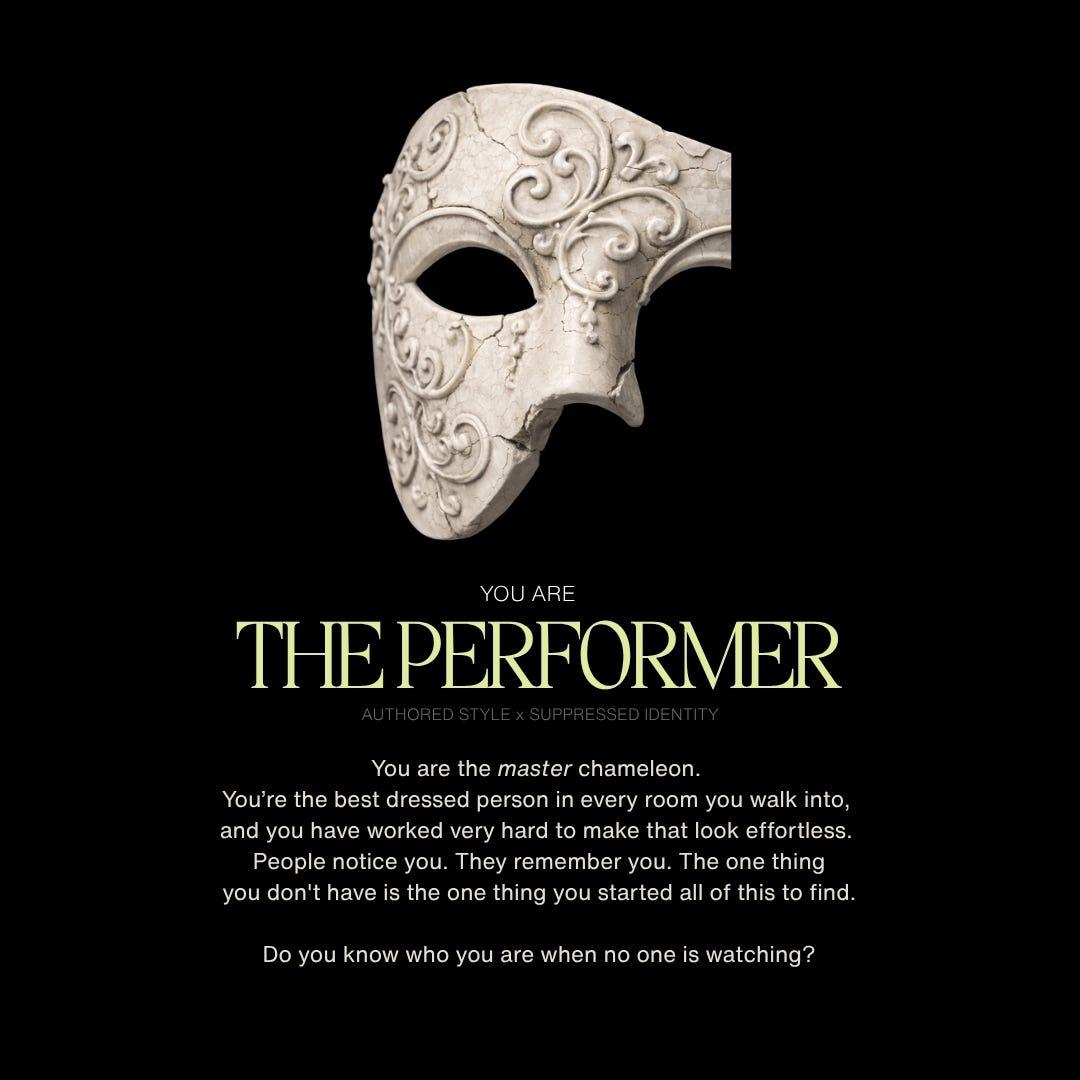
The Performer
Authored Style × Suppressed Identity
If the Performer likes your outfit, they’ll ask you who made it rather than just giving you the compliment. If you’re their friend and you told them you were wearing one thing and show up in another, they’ll make sure you don’t forget…and probably more than once. There is a slightly controlling energy around group appearance — it’s not malicious, and you’re not even sure they’re aware they’re doing it, but it’s there all the same. It’s a seemingly natural expression of someone for whom the visual stakes are always, always high.
Everything the Performer wears has been researched. Pinned. Cross-referenced against a complex internal system of what is right, what is approved, what will land the way it is intended to land. They make it look effortless. They’re your friend who has overnighted $500 of clothes for an event because the alternative felt genuinely unmanageable. The Performer understands this completely, and would never say so out loud.
They keep score, compulsively, eternally measuring. The person they’re most secretly envious of is the friend who simply doesn’t care, who throws something on. Who never even seems to think about it. The Performer has never not thought about it. And underneath all of it, quiet and patient, is an identity that has been waiting a long time to be asked its opinion.
The Anchor

Habituated Style × Expressed Identity
The Anchor gets their favorite shoes resoled every year. They pay nearly what it would cost to just replace them, and they don’t think twice about it.
They’re genuinely surprised when people compliment their style. No false modesty, no humble-brag, they’re actually surprised. In their own mind, they basically wear the same thing every day. They think of their friends who are always changing, always experimenting as the stylish ones. And yet that exact person is often the one who stops to tell the Anchor how good they look, usually in a tone that contains something more than just a compliment.
The Anchor has something that cannot be purchased or assembled: a peaceful relationship with themselves. It takes no effort and costs nothing to maintain, giving them the confidence of someone who warms every room they walk into. The Anchor just is… and they have absolutely no idea how rare they really are.
…Sound familiar? You might be onto something…
The Shadow
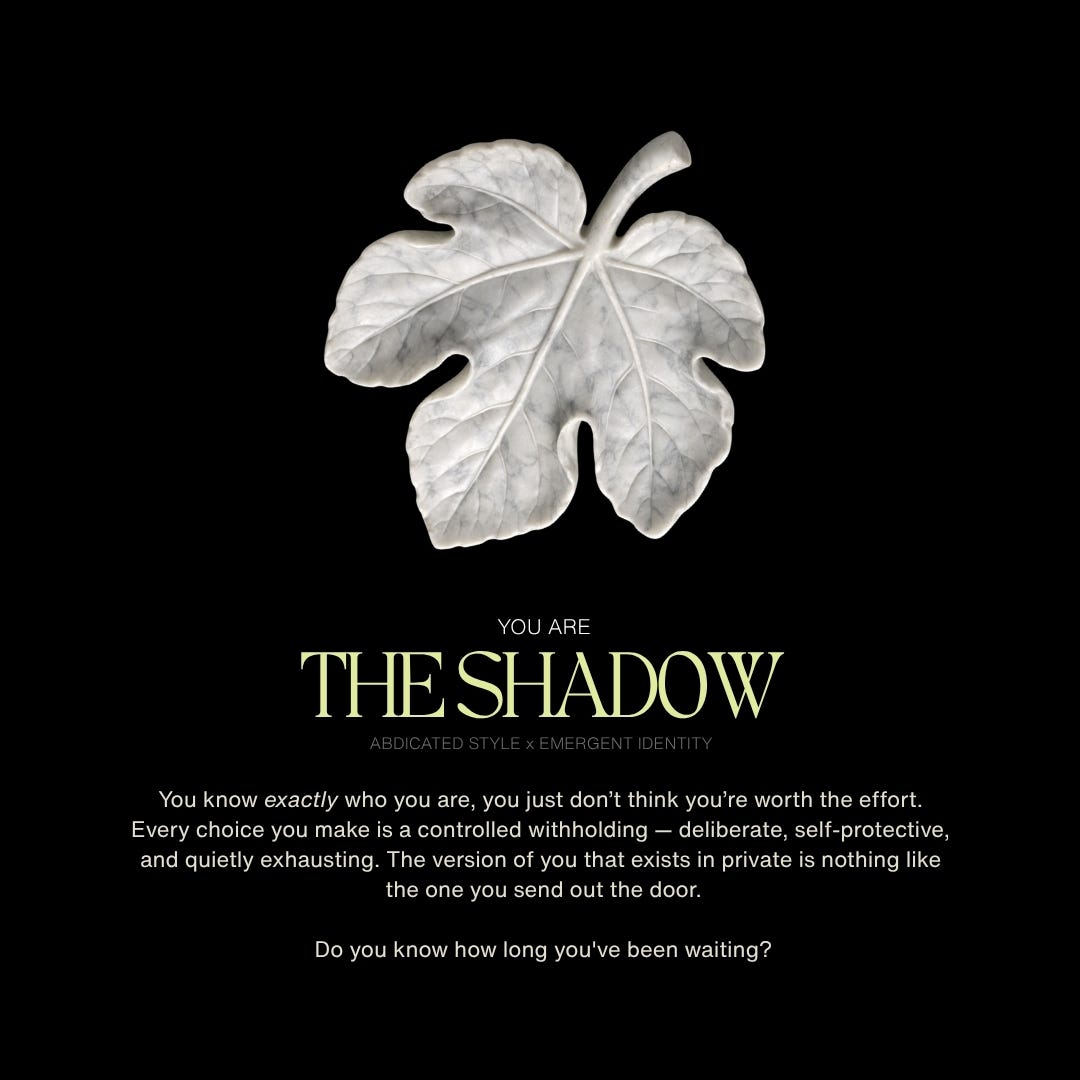
Abdicated Style × Emergent Identity
To a stranger, the Shadow leaves no impression at all. They’re perfectly presentable, agreeable, they’re the living, breathing poster child for the status-quo. There is nothing about their presentation that would cause someone to to do a double-take, and beneath the surface, this is entirely intentional.
To close friends, they’re the one texting you at 8am to ask if their top is okay, and then again at 8:14 — always about a detail so minor you didn’t even notice it until they pointed it out. Their self-doubt doesn’t announce itself to the world. It surfaces only in safety, only with the people who have already been trusted, and even then it comes out as nervous laughter, constant second-guessing, and apologizing for things that don’t require an apology.
The Shadow has a vivid, specific, fully-formed interior world. They know exactly what they like. What they lack is permission, permission they’re waiting for from a source that has never actually withheld it, because the judgment they fear has not arrived and may never arrive. They talk themselves out of the thing they love before anyone has said a single word against it. The gap between what they are drawn to and what they actually wear is significant. They feel it every day.
The Heir
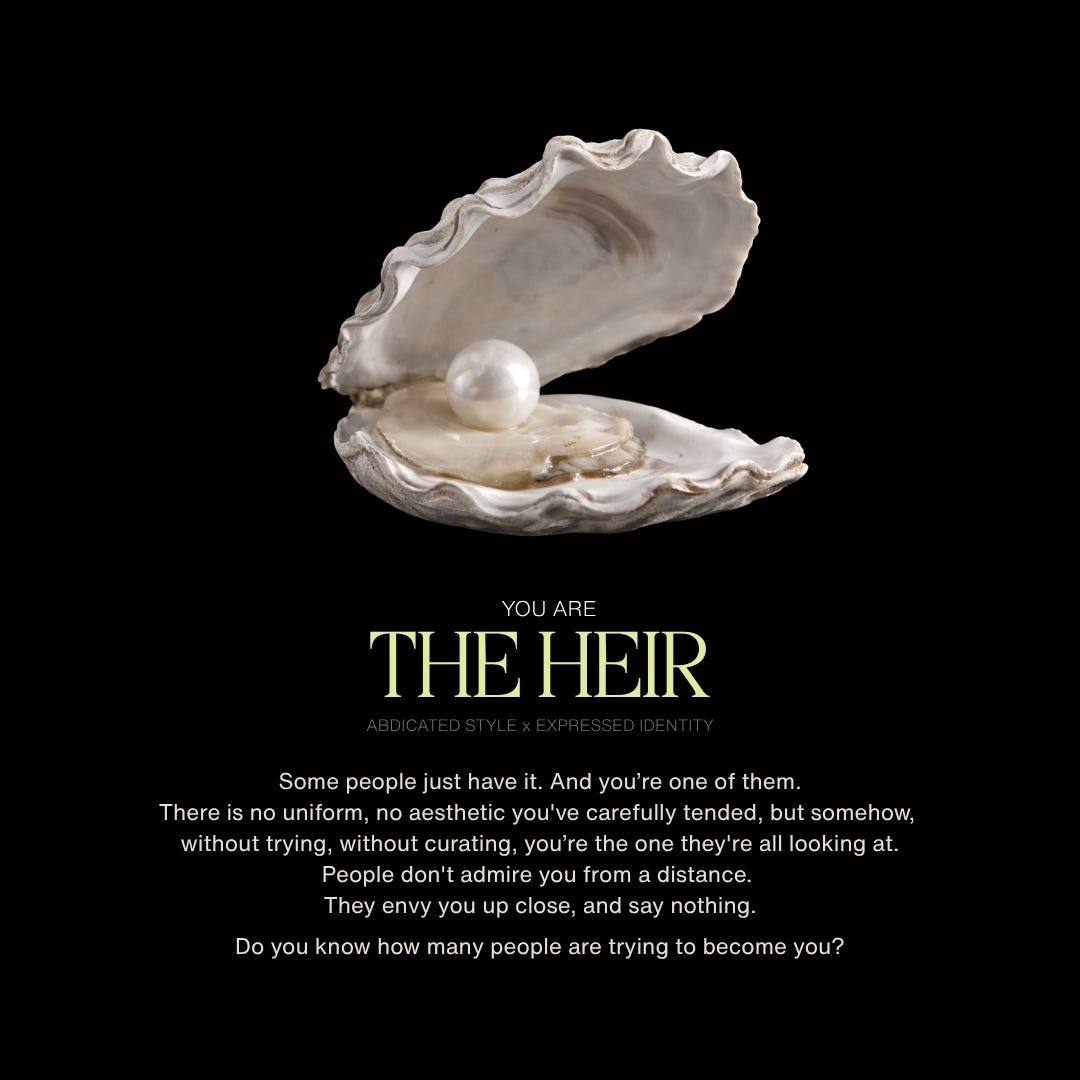
Abdicated Style × Expressed Identity
You know someone like this. The one who throws something on and arrives looking better than the people who hired a stylist. Who gets complimented on things they forgot they were wearing. Who makes effortlessness look less like a skill and more like a birthright.
You notice the piece they always wear, and ask about it. ‘This?” they say amusedly, “I’ve had this forever.’ What you don’t know is that they’ve given that answer a hundred times, and each time they’re just as surprised as the last. What puzzles them is that this is the thing people stop on — just an old ring, a worn-in jacket, a sweater they stole from their mom. It’s nothing special, per se, they just love it. They never thought anyone else would notice.
The Heir feels something close to guilt about how easily it comes — or if not guilt, a quiet bewilderment that the compliments keep arriving when they have done so little to earn them. They sometimes sense a subtle shift in how they’re treated, in how they’re spoken to, that makes them feel like they’re being studied or examined. That is the part they can’t explain. The room responds to something they cannot see in themselves.
The Seeker
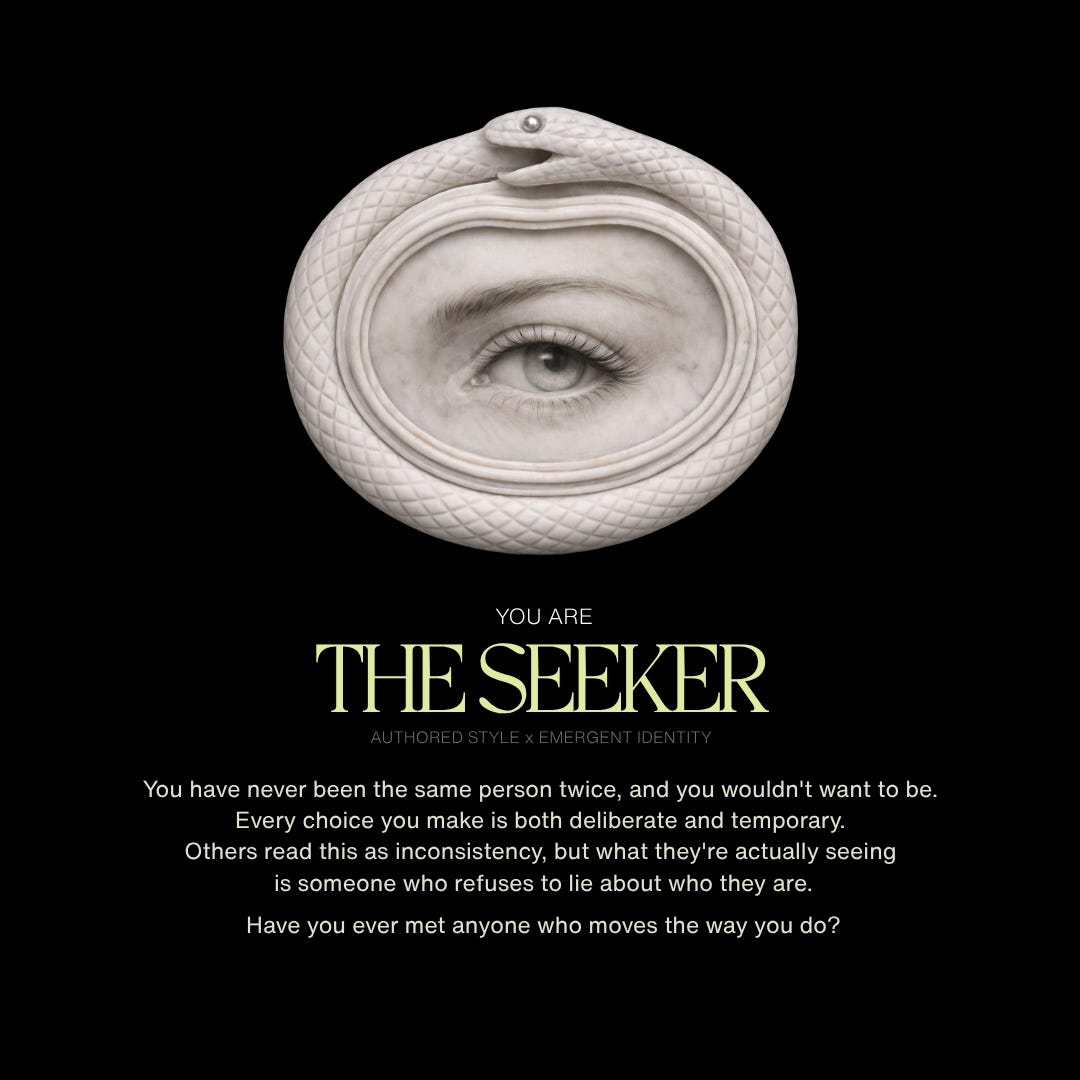
Authored Style × Emergent Identity
If you know what the Seeker has been obsessed with lately, you will immediately understand why they arrived looking the way they did. When they read The Secret History they swapped out their contacts for a pince-nez, after they came back from Paris they stopped blow-drying their hair, and the month they watched The White Lotus marked the beginning of their linen phase. When they encounter something they love, a character, a painting, a stranger on the street, there is an immediate translation impulse: How do I make this a part of me?
People commonly mistake them for being indecisive or scatterbrained, but every version is real. Every era is genuine. The Seeker changes because they are intrigued, and what they’re intrigued by keeps expanding. The Seeker is not chasing anything, they are continuously arriving.
The Sleepwalker
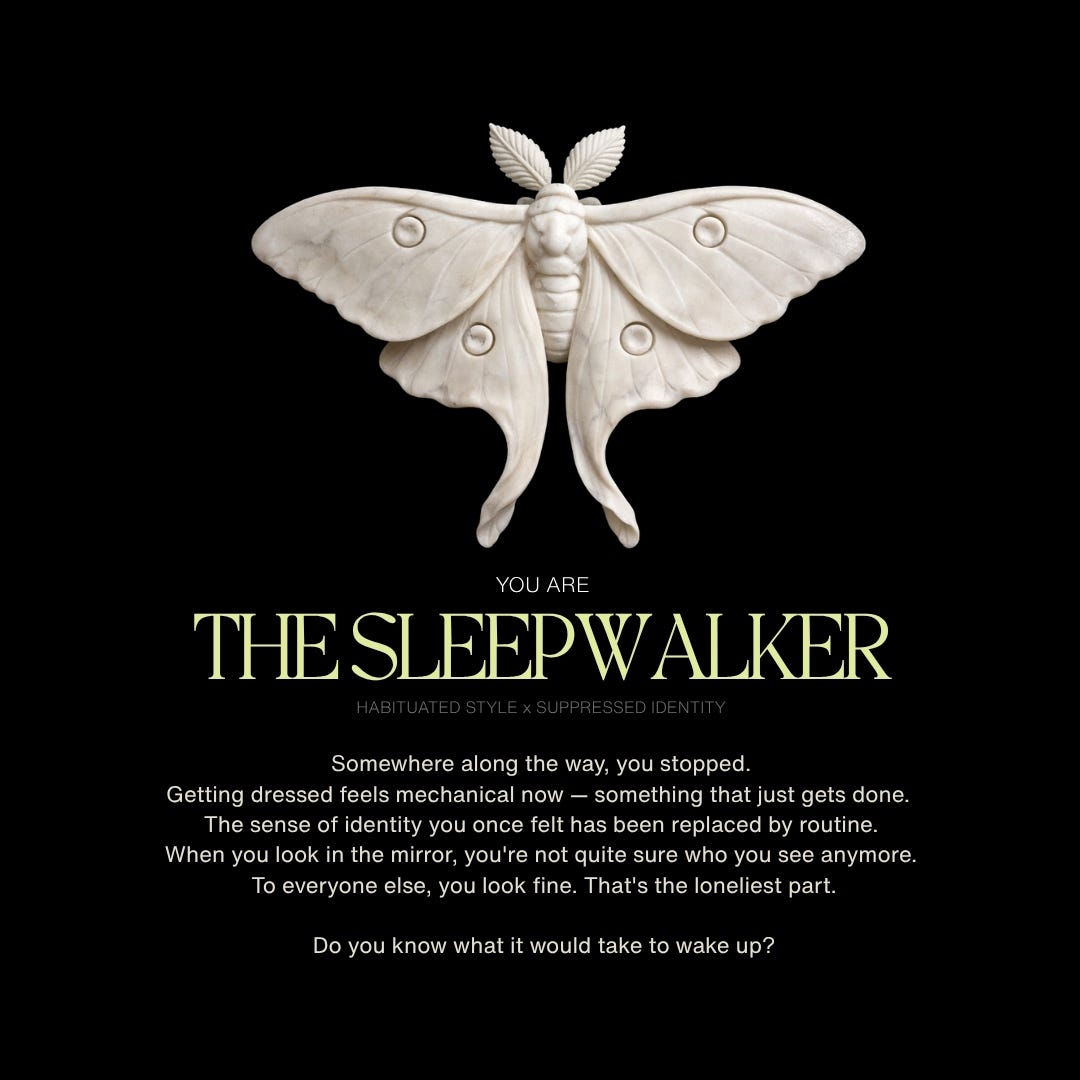
Habituated Style × Suppressed Identity
Watch the Sleepwalker pass a window display, or notice someone’s outfit. For a fraction of a second, you’ll see something flash across their face, a nearly imperceptible longing. Recognition, maybe — of who they were, or who they could be, if they just had the energy to care like that again. In the blink of an eye, the moment ends, and they continue on like nothings happened.
The Sleepwalker used to care. They know they used to care. Getting dressed used to mean something, they remember it, even though it feels like a lifetime ago. Somewhere between then and now, it all became routine. They’re burnt out in the specific, under-acknowledged way that creeps up and quietly removes things from your life until you look up one day and realize you cannot remember the last time you felt like yourself.
They feel embarrassed, and that makes it even harder to change. The gap between who they were and who they are seems impossible to bridge, and picking out an outfit is just one more impossible task. To everyone else, they look fine. That, as it turns out, is the loneliest part.
The Proxy
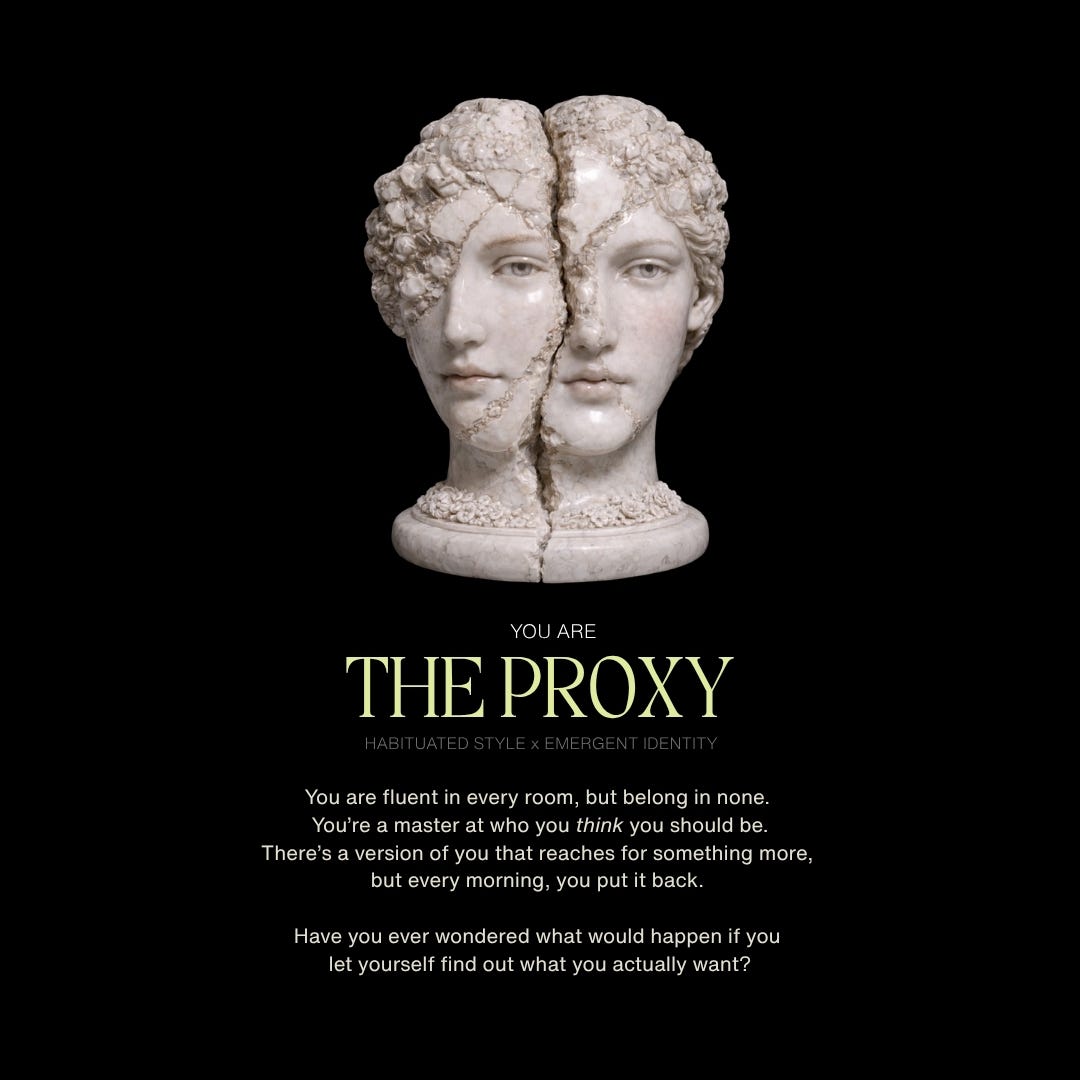
Habituated Style × Emergent Identity
The Proxy is your friend who always looks incredible, whose apartment looks like a Pinterest board, who seems to have figured out some code you haven’t — and who, if you asked them what they actually wanted — would go quiet for just a second too long before answering.
Every piece they own has been vetted, cross-referenced against the people they admire, confirmed by enough outside sources that wearing it feels safe. In a room full of people trying to figure out the right answer, the Proxy is the gold standard. They’re the ones who look like they just belong.
What no one sees is that this ‘taste’, this ‘style’, isn’t actually theirs. They’ve been borrowing it for so long it’s started to feel like their own, and they have an irrational fear that someone is going to ‘figure them out’. They’ve scanned the guest list, checked the tags for dress code, and when someone shows up wearing the exact same thing they picked out, they’re not even mad. Frankly, it’s a relief.
Sometimes they reach for something different, but they always pull back. They talk themselves out of it, and tell themselves its not practical, not really an option.
The Proxy always looks like they know exactly what they’re doing. The question is, are they actually ever doing what they want?
This is The 9 in full.
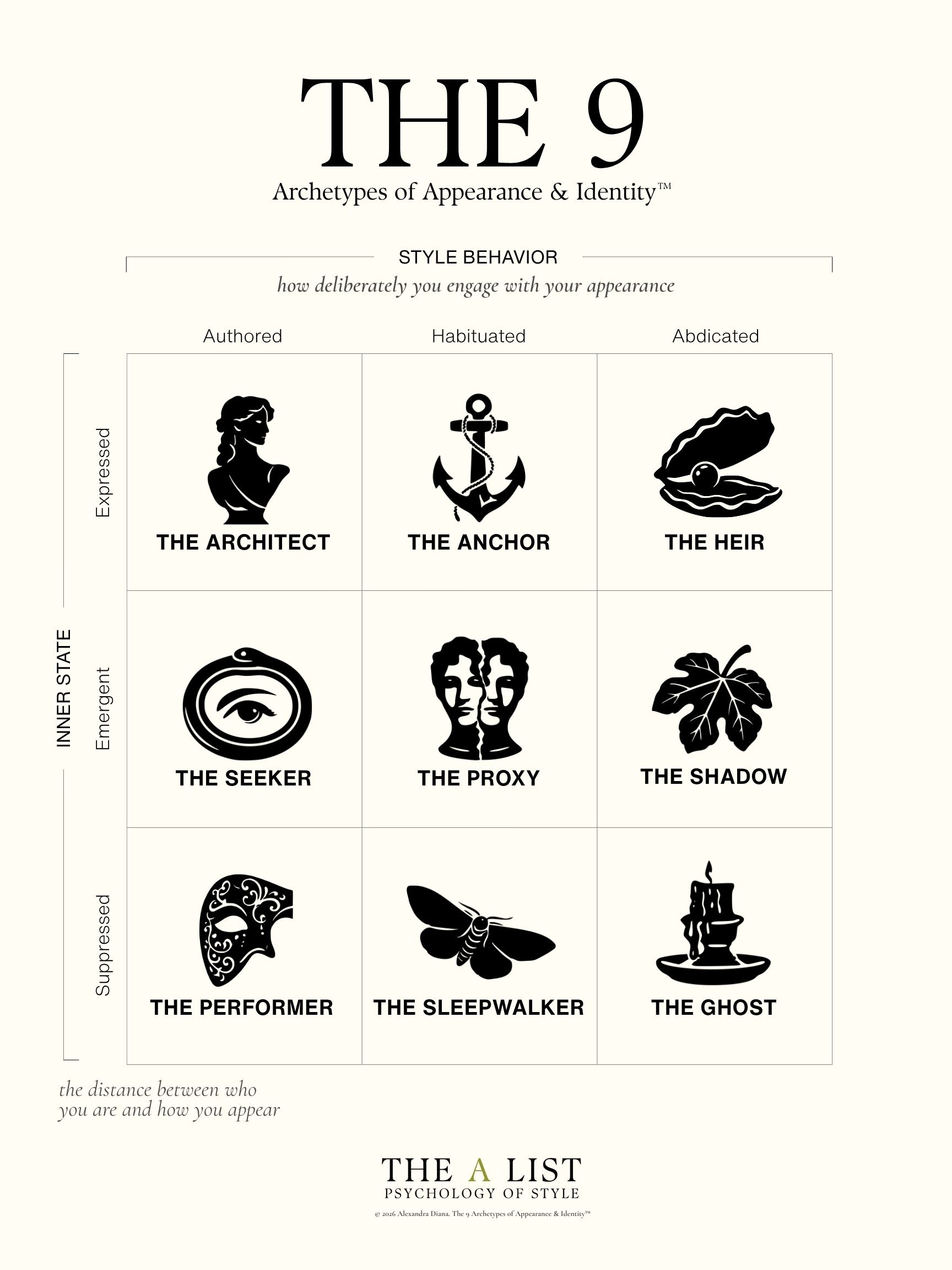
Nine positions. Two axes. One map that shows you the distance between who you are, and how you show up.
The Performer can become the Architect. The Ghost can become the Seeker. The Sleepwalker can wake up. Your archetype today is a function of where you are right now, in this moment, but you cannot move from a position you cannot see.
Most people are not failing at style, they’re succeeding at something else: minimizing who they are in a world that has a very specific opinion about who you should be. The way you get dressed is a behavioral record. It is not what you intend, it is what you do. And it’s this seemingly small, unconscious daily act that is the most accurate prediction of who you are becoming.
Your style is a self-fulfilling prophecy. You dress for the person you think you are now, and thats exactly who you turn out to be. What a profound waste it would be, to spend your one precious life trying to look like someone else.
In the coming weeks I’ll be writing more about each archetype; what it looks like from the inside, how it feels, and what it means to find yourself somewhere you didn’t expect.
For those who want to go further, POSTURE is the private curriculum. In 90 days, you will have developed a fluency in yourself that most people spend their entire lives trying to acquire. You will understand precisely what your appearance has been saying, and what it has been costing you to say it.
You have never quite looked like yourself. This is the reason why.
With great personal aesthetic,
Alexandra Diana, The A List
You did something beautiful with this writing, the quiz and the Archetypes. Thank you for sharing. It appears I'm a Seeker
A architect ♠️💎