

The hottest girl in the panopticon
The imaginary audience you're madly in love with

Standing in front of your wardrobe, you glare into the abyss.
Your fingernails dig into your hips as your index fingers tap an impatient little dance, and for the millionth time you ask yourself: What the fuuuuck am I going to wear?
You scan the tops of hangers and feel the annoyance rising, that specific, familiar irritation of someone who knows they have done this before and cannot believe they are doing it again. Your foot taps. You exhale. You start rifling.
I have to have something.
You do have something. You have everything. And somehow, standing in front of all of it, you have never felt more certain that what you have, in fact, is nothing.
It’s unbelievable; someone who shops as much as you do, who thinks about this as much as you do, should not end up here, at 7am, exhausted before the day has started. This spectacle of decisions is the performance of your lifetime, and you are but a puppet on it’s strings.
Is this too much? Is this right, for today? What if no one else is wearing something like this, what if everyone is wearing something like this? Why did I ever buy this?
That evil little voice, whispering in your ear, telling you that everything looks wrong, it doesn't belong to you. It never did. It belongs to the “audience”, the one you've been performing for every single morning without ever once stopping to ask who they are, where they came from, or why you keep letting them in.
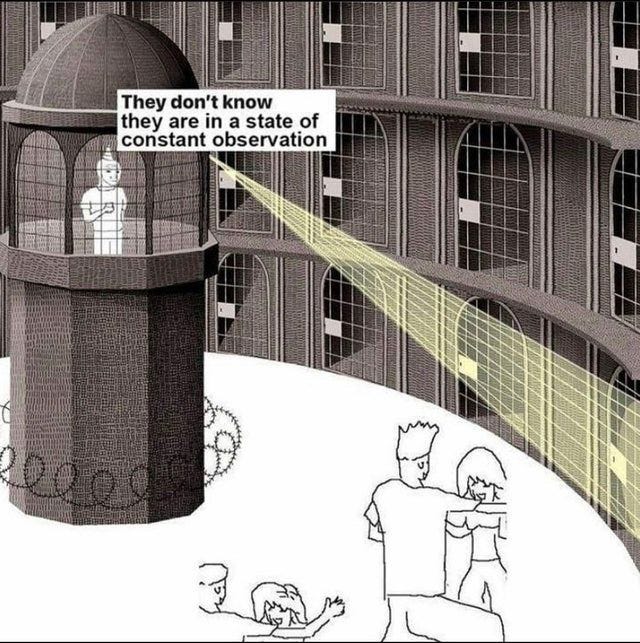
In 1791, Jeremy Bentham designed a prison where the inmates could never tell when they were being watched. They eventually stopped needing guards because the inmates started monitoring themselves so closely, it rang redundant.
Your wardrobe is that prison. And the only person watching you is yourself.
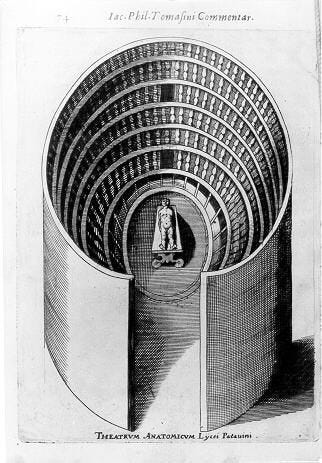
Before you could scroll, there was a watchtower.
Before anyone taught you what an aesthetic was, you already knew how to perform. You learned it at the dinner table. In the school hallway. At your first job where you understood, without anyone saying it directly, what kind of person got taken seriously, and what kind didn’t.
You may have moved, have changed, you may have dreamed of a different way, but one thing has always remained: You have always lived in the tower.*
*my literary freaks, see what I did there? ;)
We are suffering from an epidemic of sameness.
Not because people lack taste. Not because everyone secretly wants to look identical (actually, I could make an argument that people love nothing more than looking like clones, but for the sake of this article I’ll push that thought away). But because the watchtower is so loud, and the performance so exhausting, that most people have quietly made the choice to bow out, to make themselves digestible, to make the easier play. Give the world what it wants before anyone has a chance to say no, before anyone has a chance to look at you twice.
Everyone is dressed, but almost no one is actually present.
People love to blame Instagram and Tiktok, and while theres enough blame to go around, your online life isnt solely responsible for this performance. The version of you that walks into a meeting, the version of you that exists in photographs, and the version of you that stands in front of your wardrobe at 7am, they are all, now, the same continuous audience.
You didn’t escape the prison.
You just forgot you were in it.
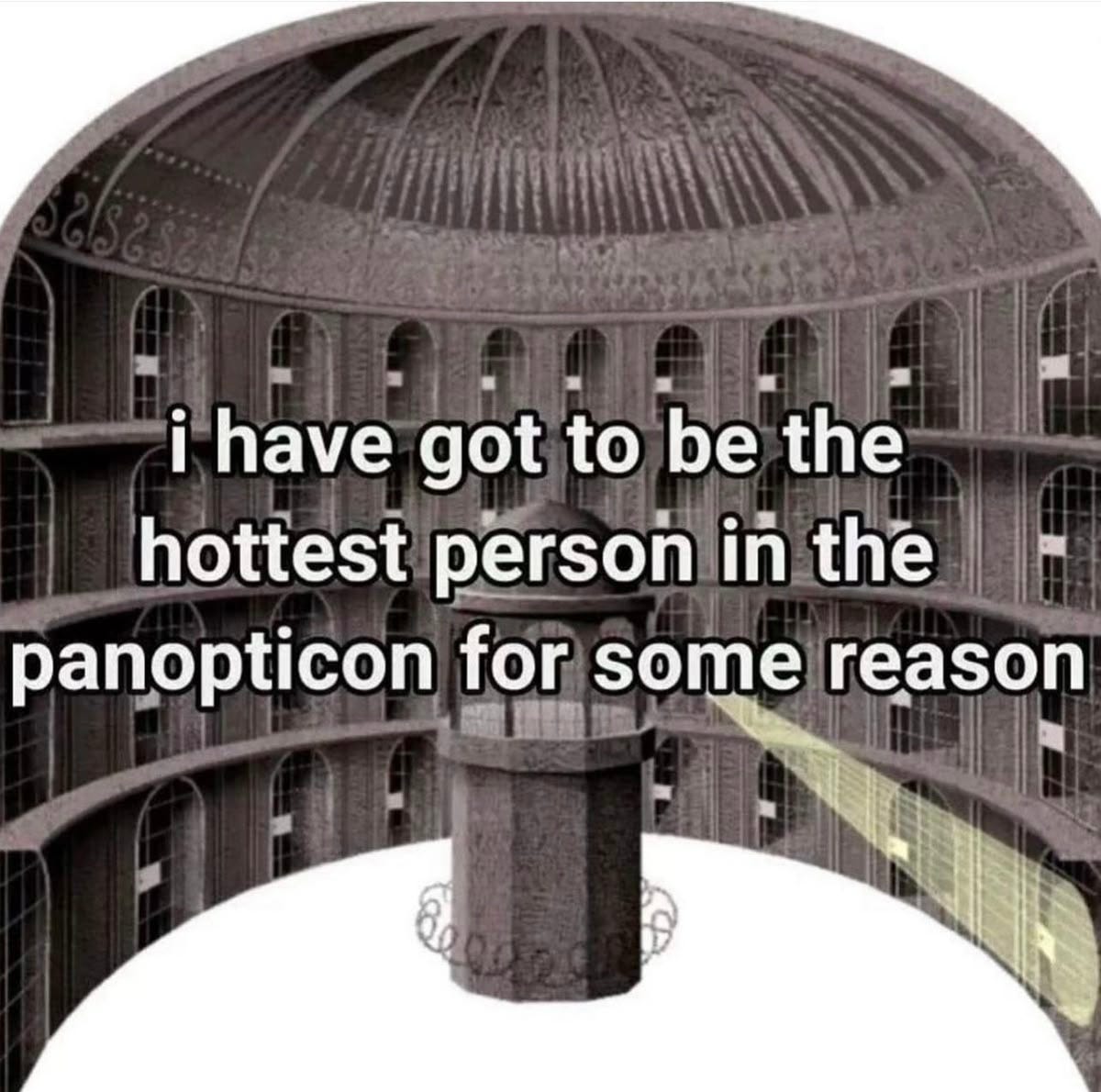
The audience in your head isn’t one person. It never was.
It’s a cast of mutilated events, opinions and oppressions all morphed together. They’ve assembled over decades, cast their own parts, and every morning when you stand in front of that wardrobe, every single one of them shows up.
Allow me to introduce!
The Critic!
Every person who ever evaluated you before you were old enough to argue back. A teacher. A parent. A boss in your first “real” job. They said something once about how you presented yourself, something they’ve completely forgotten. But you haven’t.
The Room!
What will they think? Not who specifically, just they. A nameless, faceless consensus you’ve been trying to satisfy since adolescence. The outfit that can’t be too much or too little. The one that says I tried without saying I tried too hard. The Room has never once told you what it actually wants. That’s the point. Uncertainty is what keeps you performing, and look how good you’re doing.
The Wound!
The sharp stab of an insult, the scab you pick just to see if the scar is still there. You tell yourself they don’t matter, youre the one in charge of your life, who cares what they think, anyway. Yet every time you approach it, each time you pick it enough to bleed, you bandage it up with something safer. The thing you stopped wearing…the color you put back…the version of yourself you decided was too much…away she goes, in the back of the closet, where she belongs.
The Person You Were Supposed To Be By Now!
She’s the most exhausting one. She has it together. She dresses like someone who has arrived. She chastises you for wanting to be comfortable, ridicules you each time you skip the gym, mocks you each time you see someone wearing something you long for. She has been five years ahead of you your entire life, and she reminds you every day that she always will be.
None of these people are in the room with you, but each one of them is running your wardrobe. And if they’re the ones in charge, that means you have no idea what you actually look like.
Not what you look like when you’re performing for the Critic, or softening yourself for the Room, or reaching for the person you haven’t become yet. What you look like when the audience is gone and the only question left is: what do I actually want to wear?
Most people have never answered that question.
Because in the panopticon, you are never alone long enough to ask it.
Here’s the part you’re not going to like: You cannot get out by not caring.
I know that’s the fantasy. The capsule wardrobe. The uniform. The deliberate, principled refusal to participate. I don’t think about clothes. I have more important things to focus on. The people who say this believe they have escaped the performance. They have not. They have simply outsourced their identity to someone else, and called it freedom.
The oversized hoodie worn as a statement of “not caring” is still a statement.
The person who wears the same thing every day so they doesn’t have to “think about” it is still being judged by every person, in every room they walk into.
There is no neutral. There is no exit.
There is no version of having a body in public that is not, in some way, a performance.
The people who believe otherwise aren’t free.
They’re just performing a different story about themselves, the story of a person who is somehow above all of this.
And that story?
That story is the most carefully maintained performance of all.
So if there’s no exit, there’s only one option.
You become the architect.
Not the inmate who has stopped “noticing” the tower. Not the person abandoning freedom and lazily calling it power. The architect: The one who looks at the structure directly, sees exactly who built it and why, and decides: this is not my design. Because here’s the thing about a prison you built yourself: You have the blueprint.
Who did I think I was?
That question has been running in the background of every outfit decision you have ever made. It sounds like self-doubt, but i promise, it isn’t. It’s the tower talking, the algorithm, the wound, the room, the person you haven’t become yet, all of them asking you to make yourself smaller, safer, easier, flatter, less.
The question was never who did I think I was.
The question is: who are you dressing for?
And for the first time… that answer gets to be yours.
With great personal aesthetic,
Alexandra Diana, The A List
Working on it every day, baby steps - but I'm making progress.
I built this panopticon brick by brick