

Romantic Gothic: A Guide to Embodiment
The Complete Psychological & Behavioral Blueprint for Becoming Romantic Gothic

Romantic Gothic: visual severity anchored in emotional depth.
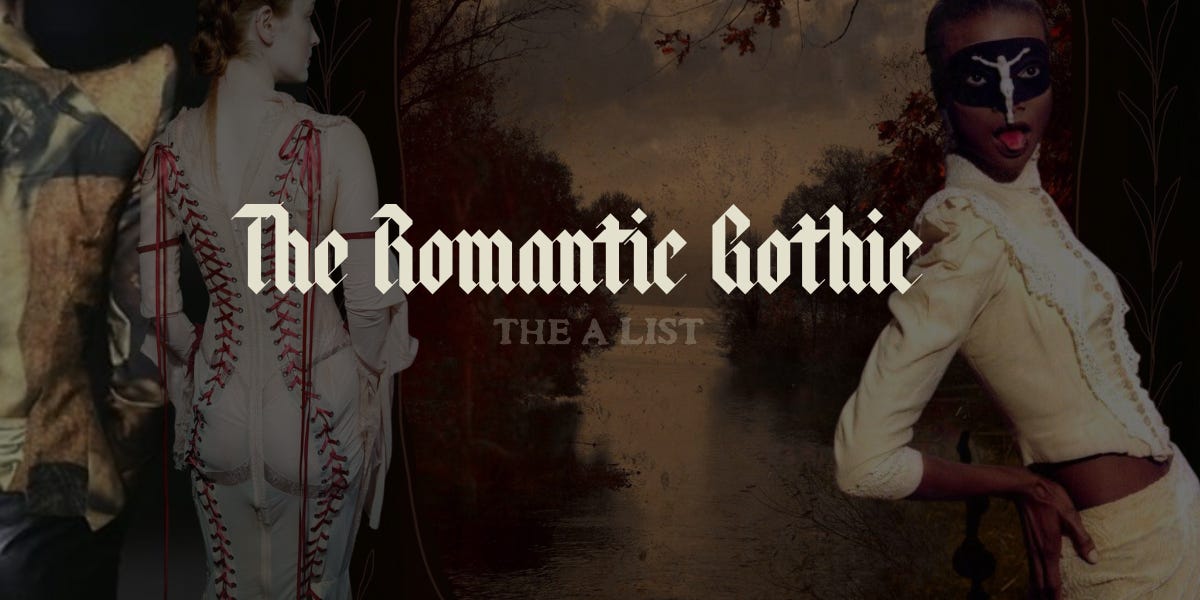
The 5 Core Competencies of the Romantic Gothic aesthetic are:
Severe silhouette, palette restriction, textural gravity, symbolic adornment, and repetition over novelty.

The Romantic Gothic took root long before it found a name.
Emerging from the fevered imagination of the Romantic movement (discussed earlier here), emotion eclipsed reason and nature was no longer pastoral, but that of the sublime. The Brontë sisters*, alongside figures such as Mary Shelley and Edgar Allan Poe, shifted literature toward intensity rather than civility. In Wuthering Heights*, attachment becomes identity. In Jane Eyre, moral conviction resists social containment, and in Frankenstein, devotion curdles into isolation. Across these works, feeling is not passive, not felt and released. It is destabilizing, it is absolute, and more often than not, it is delightfully, engagingly, murderously destructive.
*If your mental image involves Margot Robbie in couture, consider this a loving reminder that libraries are still free 🖤
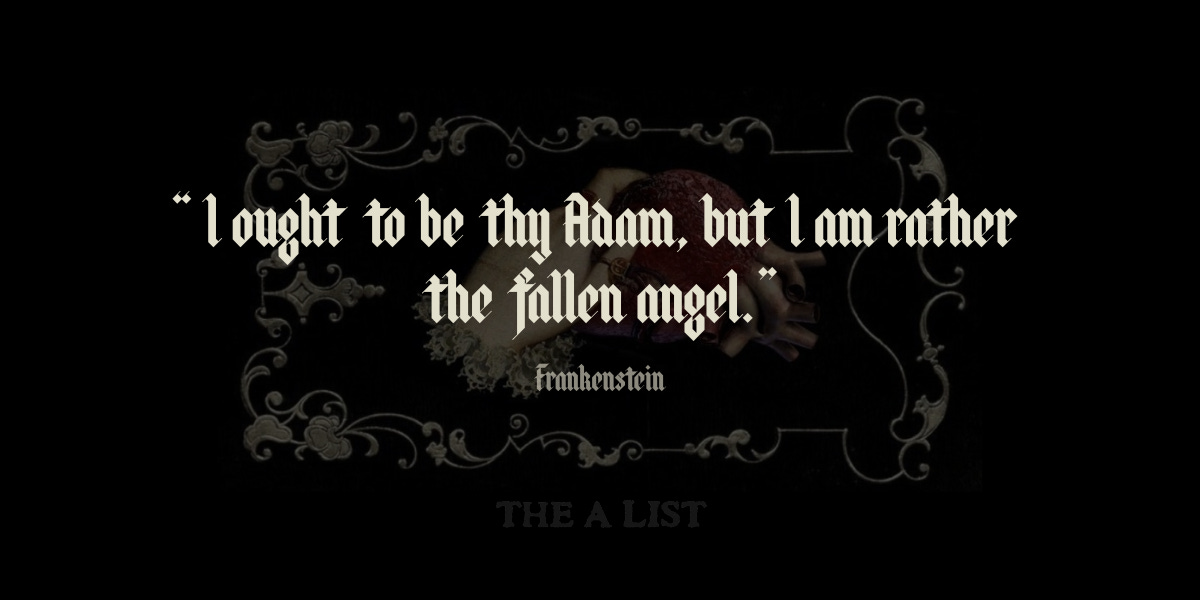
Early Victorian fashion under Queen Victoria emphasized modesty, structure, and restraint.
After the death of Prince Albert in 1861, Queen Victoria’s mourned his death until her own passing in 1901. The grief of the queen seeped into the lives of her people, as they ritualized the wearing of heavy black garments, jet jewelry, fitted bodices with long sleeves which created very striking, controlled silhouettes. These visual codes of containment and solemnity intersected with Romantic literature’s emphasis on intensity and devotion and created the aesthetic tension between emotional extremity and external discipline, the very foundation of what we now recognize as Romantic Gothic.
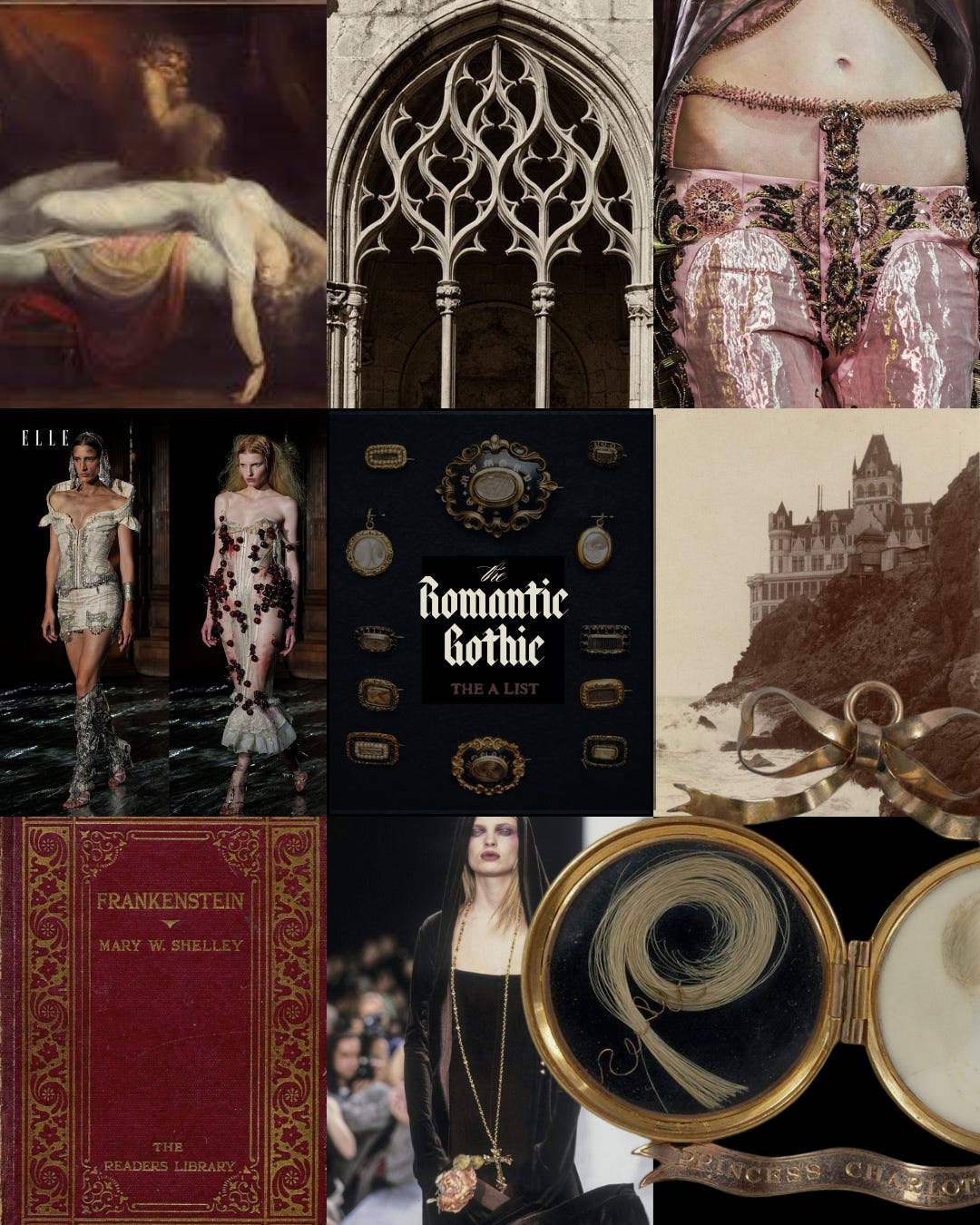
Romantic Gothic was not confined to literature, as by the mid to late 19th centruy the Pre-Raphaelite Brotherhood revived medieval subjects, the beautiful, elongated female figures and richly textured garments that went in the opposite direction of academic classicism. Artists such as John Everett Millais and Dante Gabriel Rossetti emphasized tragic heroines, saturated color, symbolic ornament, and historical dress, reinforcing the Romantic preoccupation with devotion, loss, and moral intensity.
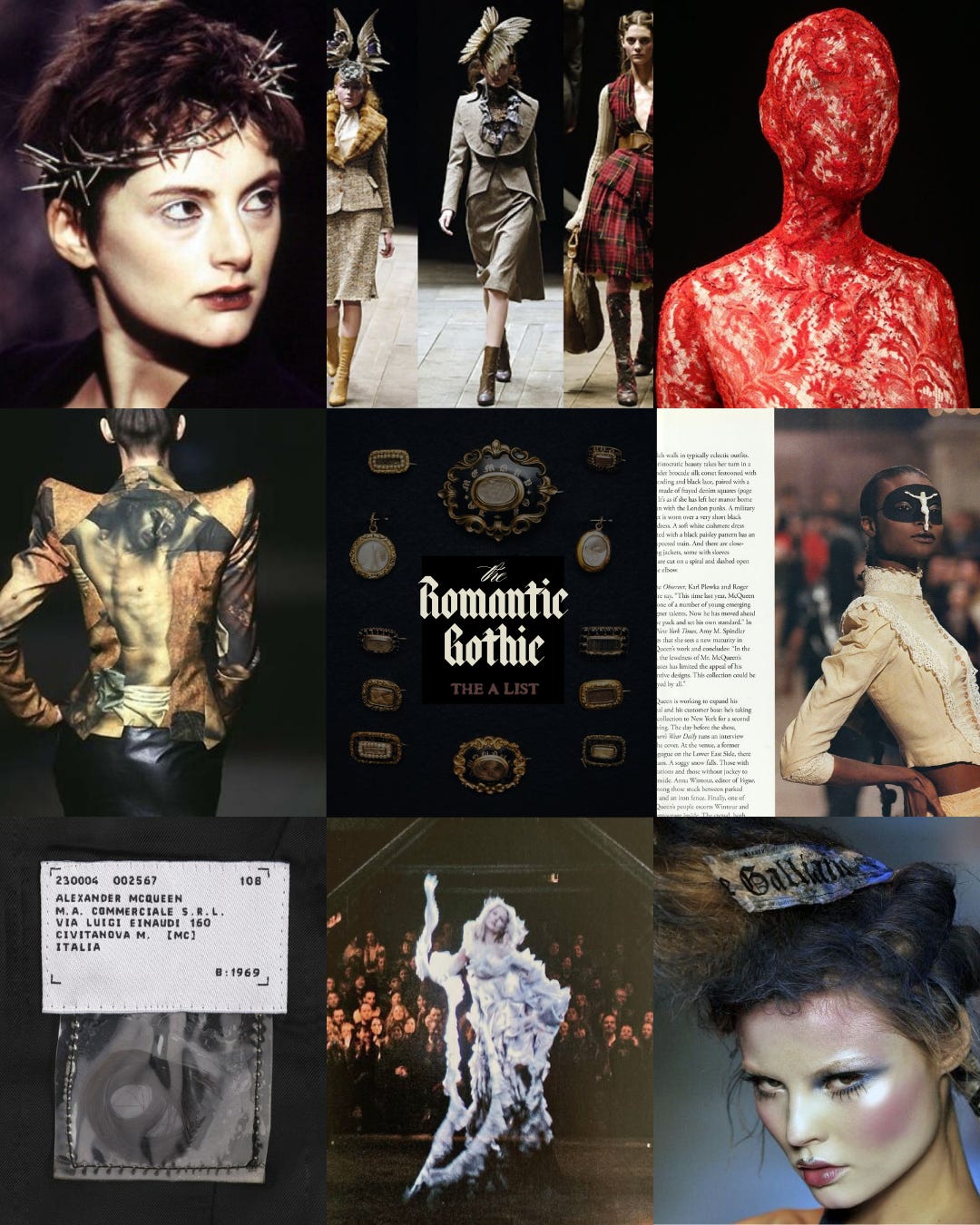
In the twentieth century, designers like Alexander McQueen repeatedly drew from Victorian mourning, Gothic literature, and religious symbolism in collections such as Dante and The Widows of Culloden, restoring corsetry, dark palettes, and ecclesiastical references to high fashion. John Galliano, particularly during his tenure at Christian Dior, reintroduced medieval and Catholic visual codes, including cruciform jewelry, velvet columns, and severe silhouettes.
Dante is the eighth collection by British fashion designer Alexander McQueen, released for the August/Winter 1996 season. Its concept was mainly inspired by the 14th century Florentine poet, writer and philosopher Dante Alighieri and his famous work Divine Comedy.
As fashion moved through modernism, minimalism, and postmodernism, the Romantic Gothic vocabulary persisted in cycles: dark palettes, structured containment, symbolic ornament, and an emphasis on psychological depth over surface decoration. Frankenstein, Jane Eyre, and Wuthering Heights continued to circulate through film, theater, and education, preserving themes of obsession, isolation, and moral extremity.
In all future installments, the section that follows will be reserved exclusively for POSTURE members. This is the only time it will ever be fully public.
THE AESTHETIC METHOD
The complete psychological and behavioral blueprint for becoming this aesthetic in real life, accomplished through the 5 Core Competencies.
There’s a reason it works on some and not on others…and its rarely the clothes.
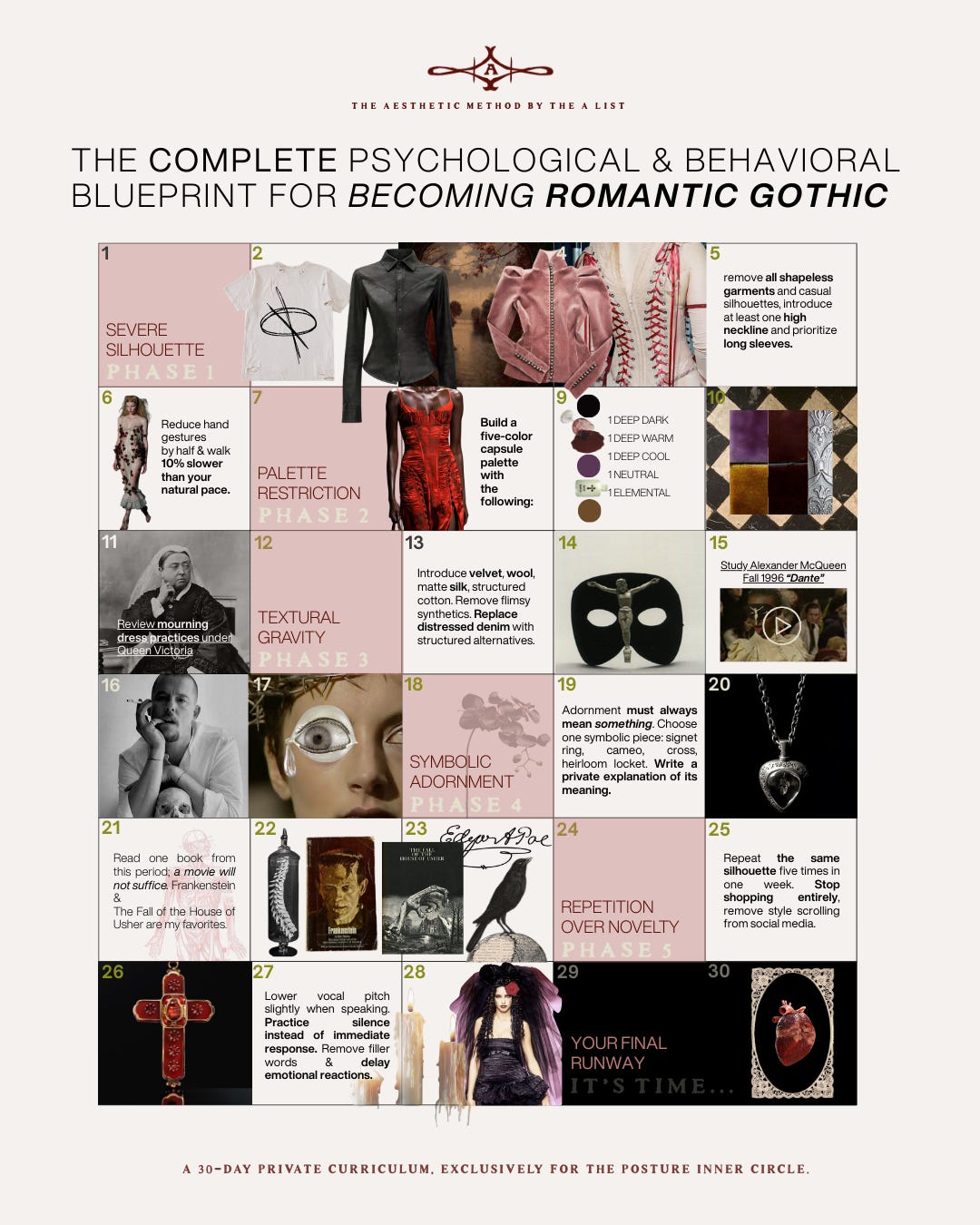
to access links included in the Blueprint, please download the document below:

PHASE I: SEVERE SILHOUETTE
Days 1–6
Romantic Gothic begins with structure. The body must look contained, vertical, and deliberate.
Wardrobe Installation
Remove shapeless garments.
Introduce at least one high neckline.
Prioritize long sleeves.
Add one structured coat or jacket with vertical emphasis.
Replace low-rise or casual silhouettes with defined waistlines.
Behavioral Installation
Sit upright without leaning back casually.
Reduce hand gestures by half.
Walk 10 percent slower than your natural pace.
Practice holding eye contact two seconds longer than comfortable.
Eliminate nervous laughter.
Study
Explore Victorian dress construction archives at the Victoria and Albert Museum
Observe Royal Posture Protocol
Voice Training Exercise: Record yourself reading one page from Wuthering Heights. Lower your pitch slightly. Slow your pace. Remove filler words.
Practice:
Stand against a wall for five minutes daily, back flat, chin level. Stillness is a trained skill.
PHASE II: PALETTE RESTRICTION
Days 7–11
Romantic Gothic does not rely on chromatic variety. It relies on restraint.
A restricted palette increases coherence, authority, and memorability. When chromatic noise decreases, structure becomes visible.
Wardrobe Installation
Remove bright white and all high-vibrancy color, such as neons and pastels
Build a five-color capsule with the following guidelines:
1 deep dark: such as black, charcoal,
1 deep warm: such as oxblood, plum, pomegranate
1 deep cool: such as forest, sapphire, emerald
1 neutral (dependent on your skin tone): such as ivory, sand, crystal, gray, bone, cream
1 elemental: such as bronze, pewter, gold, silver. mother of pearl
Avoid visible logos.
Environmental Installation
Replace bright overhead lighting with warm lamps.
Remove acrylic or high-gloss decor.
ntroduce one dark floral element: deep red roses, dried branches, muted foliage.
Study
Watch selected scenes from Jane Eyre (2011), focusing only on color and lighting
Observe how saturation is deep but limited, never scattered in The Pre-Raphaelite work.
Practice:
For five days, repeat the same dark base layer. Build everything around it. Let familiarity replace variety.
PHASE III: TEXTURAL GRAVITY
Days 12–17
Weight changes perception.
Light fabrics read casual. Gloss reads modern. Weight reads committed. Romantic Gothic requires material density.
Wardrobe Installation
Introduce velvet, wool, matte silk, or structured cotton.
Remove flimsy synthetics and thin stretch blends.
Replace overly distressed denim with structured alternatives.
Add matte leather boots.
Introduce at least one garment with visible seam structure or tailoring.
Sensory Installation
Remove overly sweet fragrances, including sugary body washes or fruit-forward scents.
Replace glossy lip products with matte formulas.
Use heavier fabrics in your environment, wool throws, linen curtains.
Replace thin plastic accessories with leather, metal, or stone.
Explore darker scent profiles: incense, vetiver, labdanum, smoky rose.
Fragrance houses to explore: Serge Lutens, Diptyque, Maison Francis Kurkdjian
Study
Understand scent training as a discipline, not a shopping spree (free download)
Psychological Anchor:
Heavier scent profiles are subconsciously associated with depth, maturity, and permanence.
PHASE IV: SYMBOLIC ADORNMENT
Days 18–23
Adornment must mean something.
Wardrobe Installation
Eliminate all trend-based accessories.
Eliminate charm bracelets and anything that moves excessively when you speak.
Replace thin chains with one heavier chain that sits deliberately at the collarbone.
Replace novelty handbags with structured, understated leather.
Ensure your sleeves and collars frame your layers, rather than crowd it.
If wearing a cross or cameo, keep the rest of the jewelry minimal, no additional focal points.
Behavioral Installation
Keep your chin level when referenced.
Speak one sentence fewer than you normally would.
Do not play with jewelry while speaking.
Understand: Romantic Gothic adornment does not seek validation. It tolerates projection.
Study
Explore Victorian mourning jewelry
Read (for free!) chapters of: Frankenstein by Mary Shelley, Wuthering Heights by Emily Brontë
The Metropolitan Museum of Art, Reliquary Collection
Become a (free) member of The Morbid Anatomy Library
Practice:
Choose one symbolic piece of jewelry to wear. For three days, wear no jewelry except your chosen symbol. Write (by hand) a private explanation of its significance.
PHASE V: REPETITION OVER NOVELTY
Days 24–30
This is where the aesthetic stabilizes. If Romantic Gothic is to become identity rather than performance, it must be predictable.
Wardrobe Installation
Repeat the same silhouette five times in one week.
Rotate the same boots repeatedly.
Stop shopping entirely for seven days.
Remove style scrolling from social media.
The goal is recognizability.
Behavioral Installation
Lower vocal pitch slightly when speaking.
Practice silence instead of immediate response.
Remove filler words.
Delay emotional reactions.
Keep your pace of movement steady across environments.
Do not suddenly over-animate in social settings.
Repetition builds expectation. Expectation builds authority.
Study
The Mere Exposure Effect: How you can become more likable and powerful by doing one, simple thing.
Gothic Revival Architecture: how medieval forms were repeated in the 19th century to create continuity with the past.
The recurring motifs in The Raven by Edgar Allan Poe, note how his repetition is not subtle, it’s obsessive.
Study how Dante Gabriel Rossetti paints the same elongated face, same parted lips, same heavy hair across works.
Psychological Anchor:
Predictability in presentation creates certainty in perception.
THE COMPLETE INTELLECTUAL IMMERSION SYLLABUS
Read (for free!)
Wuthering Heights, Jane Eyre, Frankenstein, Dracula, The Raven, Lord Byron
Watch
ANN DEMEULEMEESTER Spring Summer 1996 Paris
John Galliano for Christian Dior, Fall 2000, Haute Couture
Alexander McQueen, Fall 2006, “Widows of Culloden”
Witness
Ophelia (1851–1852) — John Everett Millais
A study in stillness, enclosure, and devotional attention to detail. Notice the vertical containment of the body within dense natural repetition.
The Bride of Lammermoor (c. 1830) — Eugène Delacroix
Observe emotional extremity held within compositional discipline. Color is deep, not scattered.
The Monk by the Sea (1808–1810) — Caspar David Friedrich
A single figure dwarfed by atmosphere. Study negative space, horizon line, and tonal restraint.
Beata Beatrix (1864–1870) — Dante Gabriel Rossetti
Devotion embodied. Notice repetition of face type, palette control, and symbolic objects.
Saturn Devouring His Son (1819–1823) — Francisco Goya
Psychological darkness rendered through shadow density and restrained color.
DAY 30: Your Final Runway
Curate one full Romantic Gothic look and photograph it in low, natural light. Focus on your posture, your control, your decorations, your palette. Take everything you have learned, and ask yourself:
Is my silhouette controlled?
Is my palette disciplined?
Do the textures in my outfit hold, or weigh me down?
Is my adornment intentional or for attention?
If this became your default, what part of you would resist it?
What standard would you have to uphold to keep it believable?
What does this look commit you to, and what behavior of yours would contradict it?
If you have accomplished this completely, you will have become someone new, someone worthy of the Romantic Gothic.
Find peace and internal calm in the quest for self, yearn for the devotion to become more than merely mortal, and above all, to thine own self, be true.
Your power is greater than even you can know.
With great personal aesthetic,
Alexandra Diana, The A List
