
The Confidence Scam
How “fake it till you make it” breeds the very insecurity it promises to cure.

POSTURE is the exclusive syllabus on identity, aesthetic reinforcement, and the self-fulfilling nature of style.
I. Orientation
Greetings and salutations. It’s me! Your Curator of Aesthetic Intellect, and, against my better judgment, I have a story to tell.
For the past two months, I have been inhabiting a most unnatural character: the person who posts on social media, who, brace yourself, speaks about themselves and promotes their own work. The experience has been, to put it mildly, biochemically repugnant.
Three months ago, the mere thought of 'self-promotion made my skin itch. Comfortability was a long-lost friend. The idea of releasing my prodigious brainchildren into the digital abyss, where anyone could trample through my garden and leave muddy footprints on the carpet Calvin and Hobbes style, was unthinkable. I was very much taught to keep myself out of the spotlight, to be gracious with the gifts and talents you possess and never assume that the world revolves around you. All somewhat-wonderful ideas, until you decide to abandon the prescribed nine-to-five notion (as someone who literally lived on Wall Street, the irony curls my toes), and realize that at some point, if you plan to escape the machinery, youre going to have to start speaking a little louder than it hums. *Internally screams*
And so, for what felt like the thousandth time, I reached for my tried and true, my weighted blanket of self-improvement: fake it till you make it.
But this time, it didn’t work.
This time, I understand what it really is: the greatest lie in modern psychology.
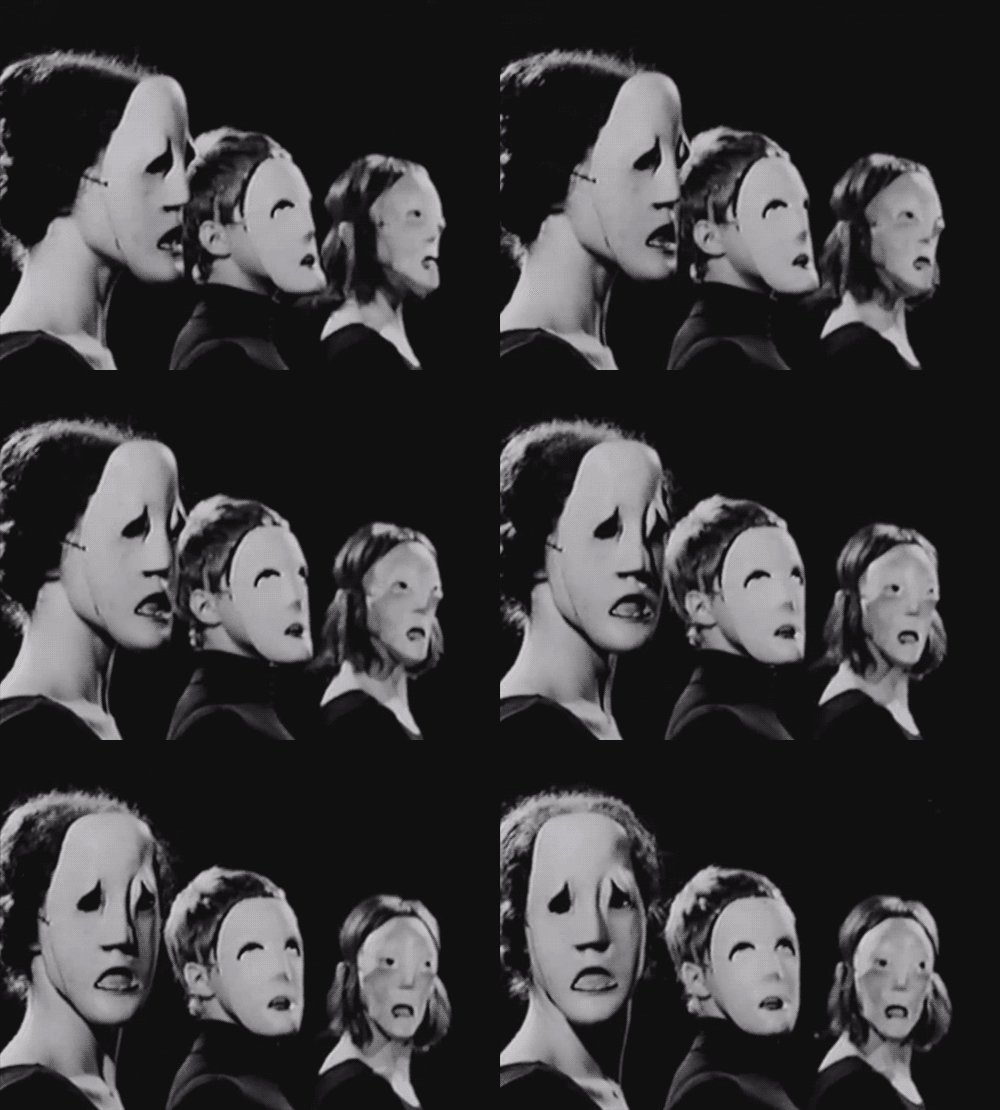
I used to live by the fake it till you make it rule.
I thought it signaled confidence, power, precision, that it let me play benevolent caretaker to my favorite creation: myself. I treated her like a character in a game, my favorite Sim, and she was endlessly editing, constantly calibrating, searching through the synth for manifested perfection. For a while, this illusion worked incredibly well.
The conundrum was this: it always failed. There was always a small piece of me that even when surrounded by proof, I wondered how real it was, or if it would remain. That’s what can make putting yourself out there, on social media and beyond, so terrifying: the numbers can go up just as quick as they can slam back down. When you don’t know who you are, which is the inevitable side effect of “faking it”, you start broadcasting contradictions: gestures that don’t match your tone, clothing that doesn’t match your alleged conviction. No matter how you dress, you’ll look like you’re auditioning for a role, no matter how you present yourself you still have to present yourself, you can’t just be.
The more you tell yourself you’re faking it, the more that feeling of lack, shame, imposter, will remain. The more that sensation of falseness calcifies. Every repetition deepens the belief that you’re not yet enough. There is no fake it till you make it. You have to believe it to become it. To believe it you must be confident.
Pretense is not a bridge to confidence; it is a rehearsal of insufficiency.
The biochemistry of pretending proves this method is destined to fail.
One of the biggest lies we tell ourselves is that we are not confident enough to become what we want to be.
Hear me when I say (!!!) : You already have confidence, it’s simply misdirected. How do I know this? Because you’re confident in your incapacity.
You state, I’m not good at this, with absolute authority. You believe your own doubt, unwaveringly. So it isn’t that you lack confidence, it’s that you’re misdirecting its power. The task isn’t to perform assurance; it’s to redirect it. To see that belief, once reoriented, is the only style that will ever, truly, be yours.
By the end of this essay, I will prove to you the how and why of this simulation collapse so clearly that you’ll finally be able to replace performance with precision. How you can transform the low-hanging fruit of “faking it” into a harvest of genuine authority.
Keep reading with a 7-day free trial
Subscribe to THE A LIST to keep reading this post and get 7 days of free access to the full post archives.