

We killed her twice
The psychological evolution of Carolyn Bessette-Kennedy's style and identity

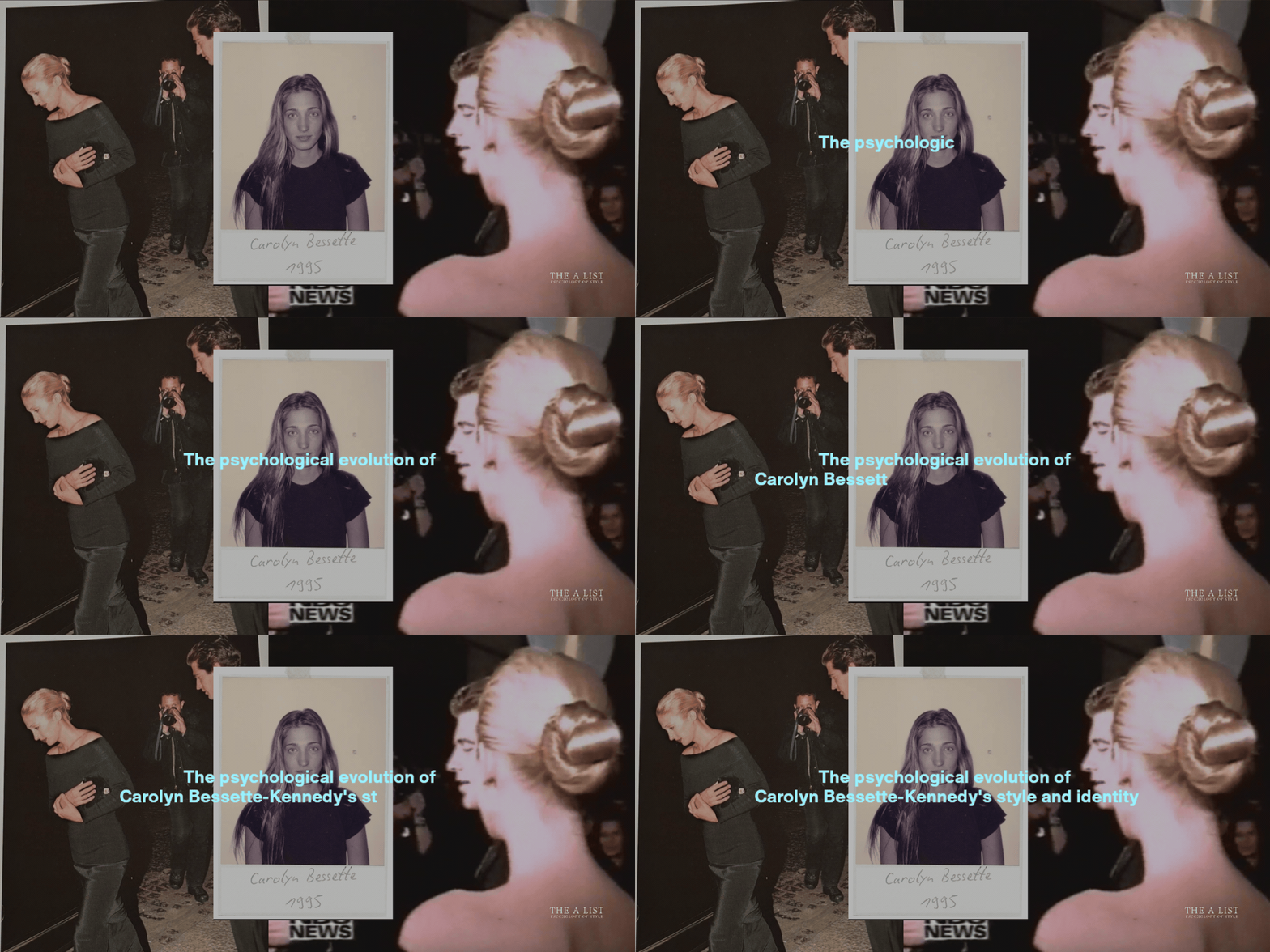
The level of devotion she’s conjured is nearly mythological in stature.
The way people talk about her, grope for her, the obsession around Carolyn Bessette-Kennedy fascinates me far more than Carolyn Bessette-Kennedy herself.
There are several parts of the obsession I understand. I see the same radiant woman that you do. I love how when you describe her it could sound like anyone, but when you see a photo of her, she looks like no one else. I love how her minimalistic style makes a maximalist such as myself impressed.
I think one of the reasons we are so infatuated with her is this range of emotions we see, it makes us feel like we know her. Coupled with the fact that she never gave an interview, was repelled by the very idea of exposing herself to our para-social impulses, we’ve morphed her into this amalgamation of who we think she was, We made her into this amalgamation of who we think she was and what we need her to be, and I am both drawn to write this and repelled by the idea of it in equal measure.
If you read what people wrote about her then, compared to what they write about her now, you wouldn’t think it was the same person. I felt like such a voyeur, reading everything I did, because I just know that she would fucking hate that I’m doing this at all. At least Diana was loved while she was alive.
The more I read about Carolyn, the more I’m convinced that your style is a self-fulfilling prophecy. What you wear shapes how you behave, how the world responds, and who you eventually become. Therefore, style is not metaphorical. It’s behavioral.
Carolyn Bessette-Kennedy never got to write her own prophecy. The clothes she wore when she was trying to disappear from sight are the ones we’ve latched on to all these years later, and theres something sickly and so American to me about the fact that she never wanted to be an icon, so we burned her alive and when she was dead, we finally got what we wanted.
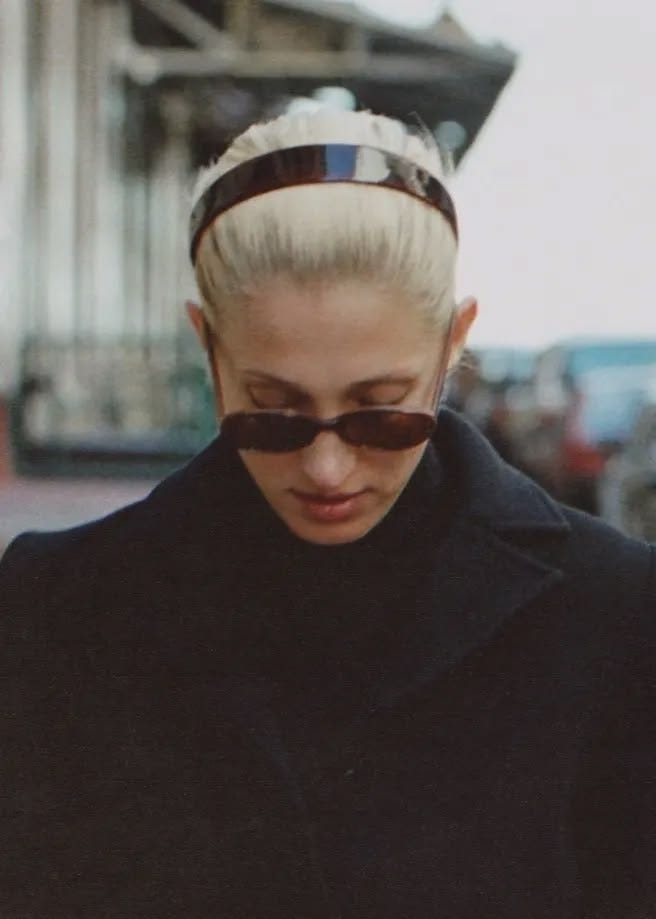
THE HEIR
Abdicated Style × Expressed Identity
The Heir doesn’t dress to be seen, she just is. When I initially began this piece, I was certain that this would be Carolyn’s defining archetype. How incorrect I was.
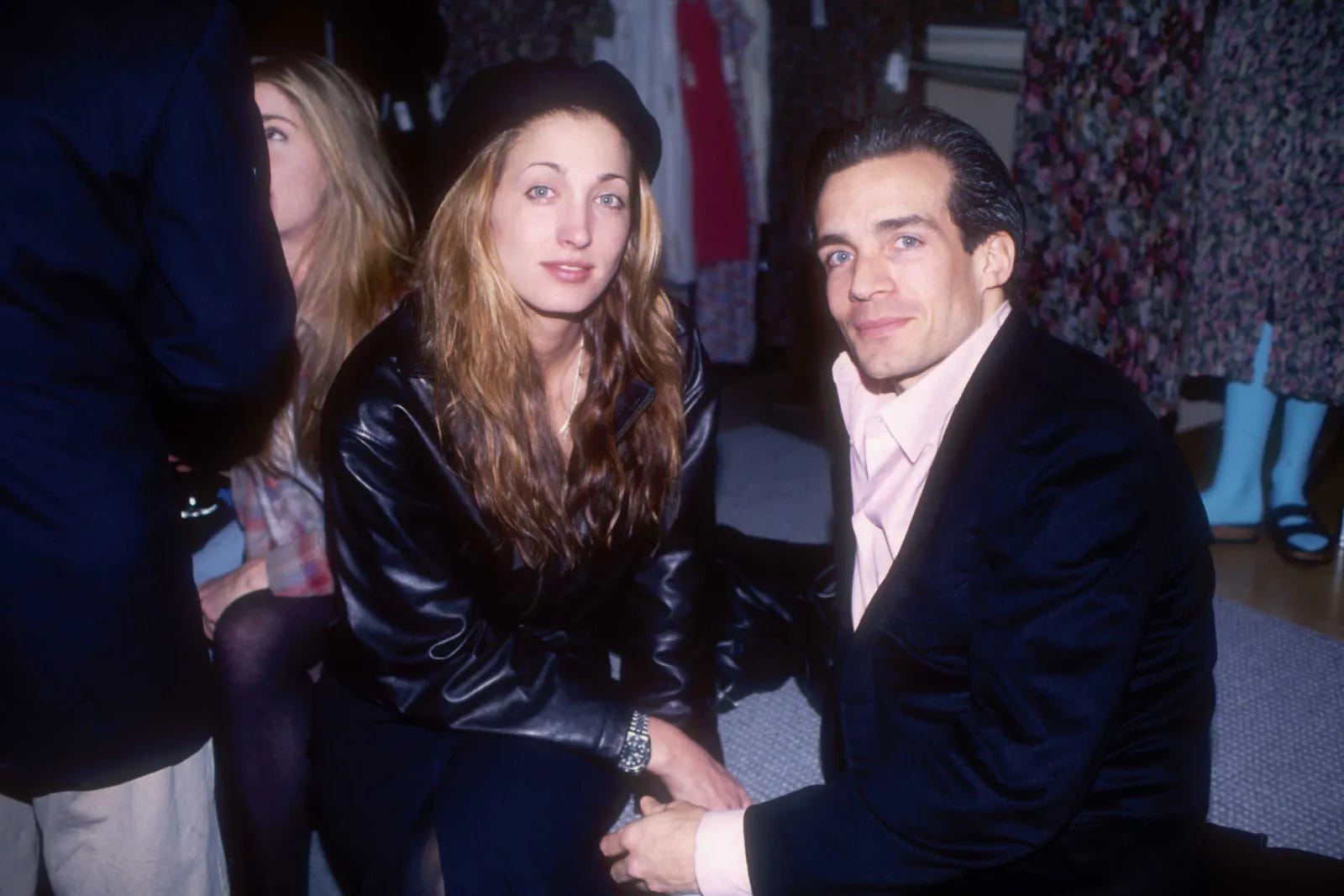
Carolyn Bessette grew up in Greenwich, Connecticut, the youngest of three daughters of a cabinet-maker and a public school administrator. She grew up adjacent to wealth but not immersed in it, which highlights the key difference in her style to those in the truly affluent world, I don’t think she had anything to prove. She went to Boston University and stayed in Boston after she graduated, working as a saleswoman at the Calvin Klein store at the Chestnut Hill Mall during the day and moonlighting at marketing nightclubs in the evening. On one fateful day, she was noticed by Susan Sokol, the president of Calvin Klein Collection, who came through on a sales visit. Thinking Carolyn was the embodiment of the Calvin Klein muse, she was Cinderella-ed to the New York office, where she spent the next seven years being promoted from VIP of Client Relations, to Director of Publicity, and finally Director of Show Productions. She earned what biographers describe as a low six-figure salary — which in today's money is approximately $210,000 (not bad for a girl who was ringing up discount merchandise a few years earlier).
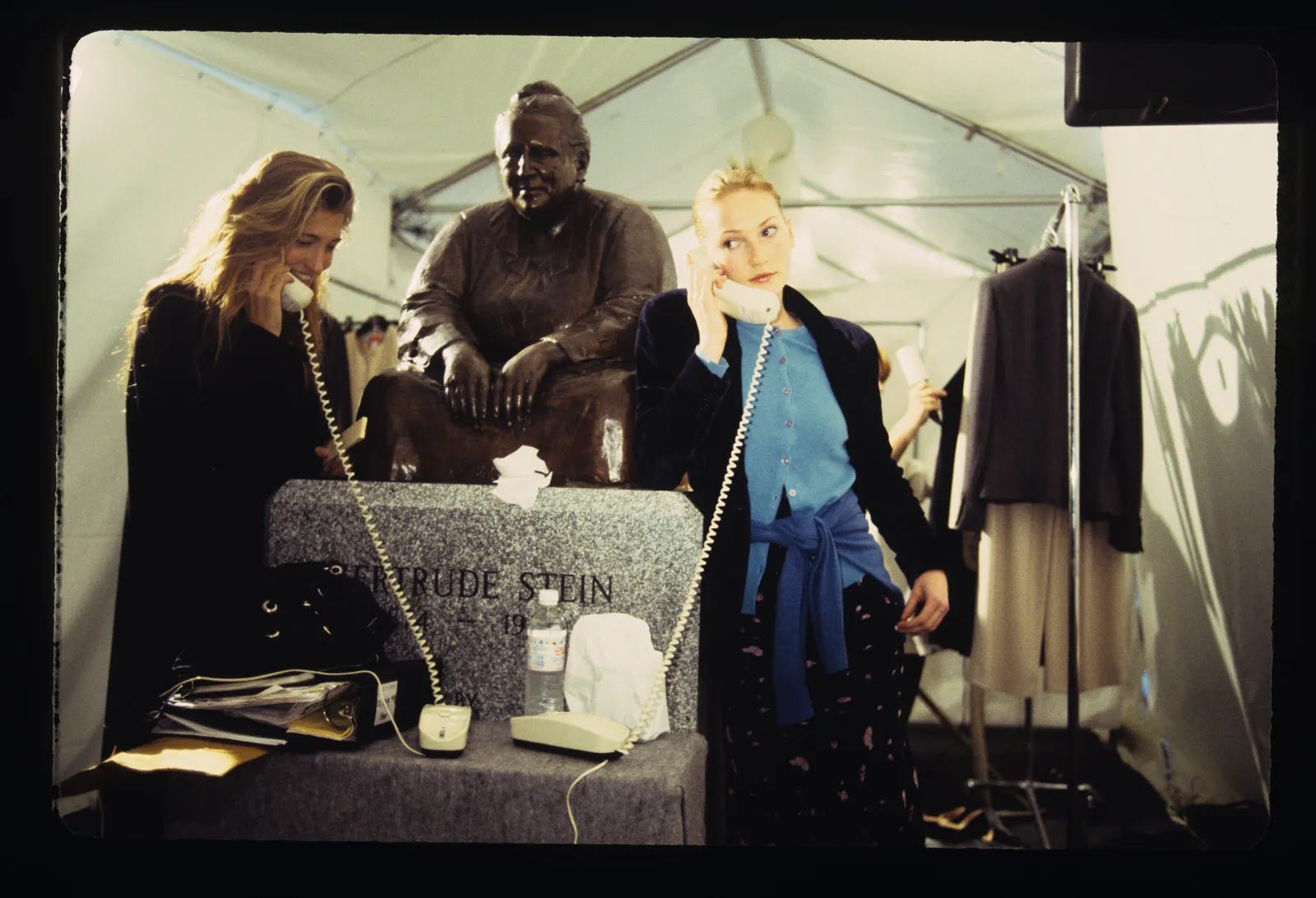
The Calvin Klein office had a dress code so precise it read more like a manifesto. Employees were required to wear CK head-to-toe, surrounded by walls that were repainted white daily to cover scuff marks. Nail polish was banned, makeup had to be near-invisible, desks had to be bare. The entire point was uniformity, and it seemed to work quite well.
At first glance, CBK was the white knight of this aesthetic. But the more i looked the more I saw someone different. Past the minimalism, buried beneath my assumptions, was someone else: Carolyn, who wore blue nail polish. Carolyn, who pulled shirts from the menswear section and paired Chuck Taylors with midi skirts. Carolyn, who wore a leather jacket to the office as a blouse. I want to be very clear about these actions because it’s so easy to misunderstand: Carolyn was not being subversive. I don’t think for a minute her instinct was to rebel, frankly, I don’t know if this word would have even crossed her mind. This isn’t the same behavioral calling card that makes some people wear funny socks with proper suits, a nod to her hidden individuality. This is the very nature of The Heir. The Heir doesn't carefully construct her style, doesn't flirt with social codes or try to paint outside the lines. It simply already exists, fully formed. She knew her style the way some people know their side of the bed, and in everything I poured over to write this piece, there is not a single shred of evidence that she ever deliberated over what to wear. Carolyn produced an enormous amount of evidence of her taste without appearing to think about it at all. There is no gap between who she is and how she looks.
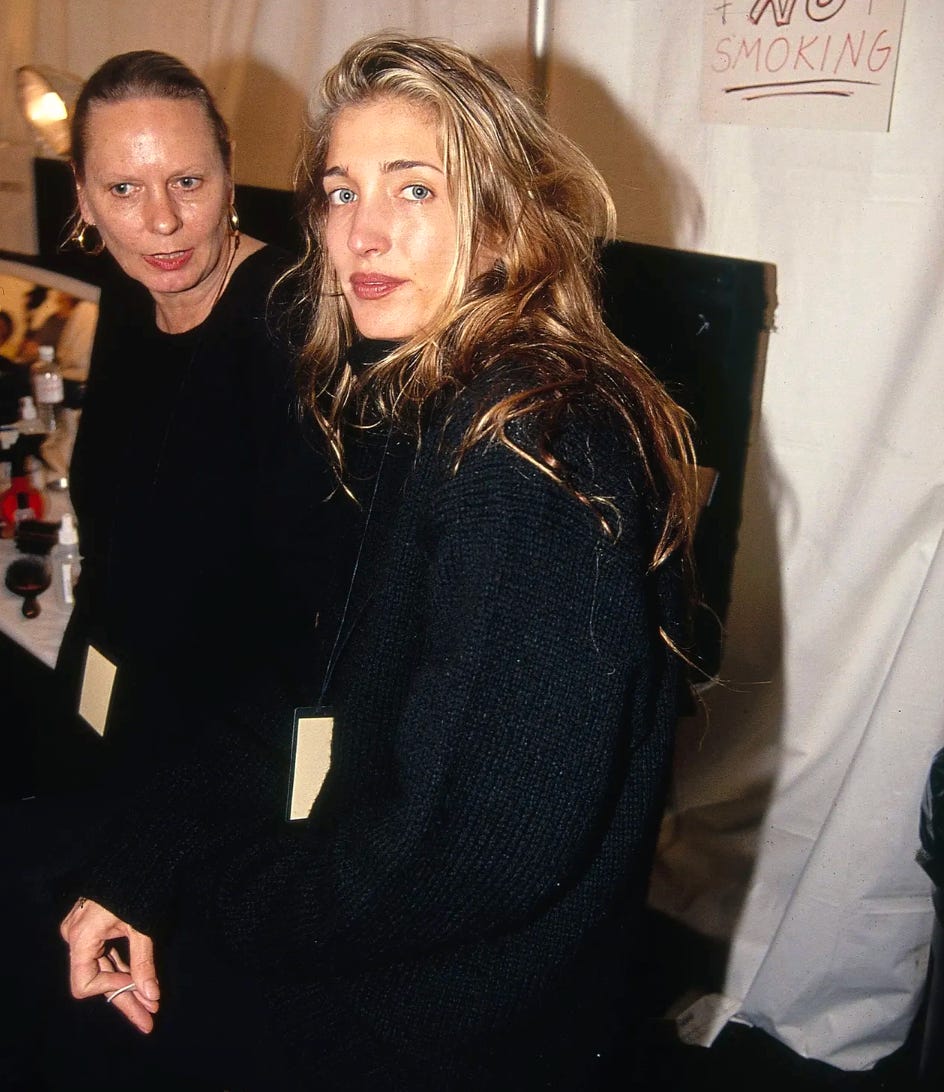
Knowing this makes what comes next much harder to write, because what comes next is the woman she was forced to become, by people who had no idea what they were destroying.
THE PROXY
Habituated Style x Emergent Identity
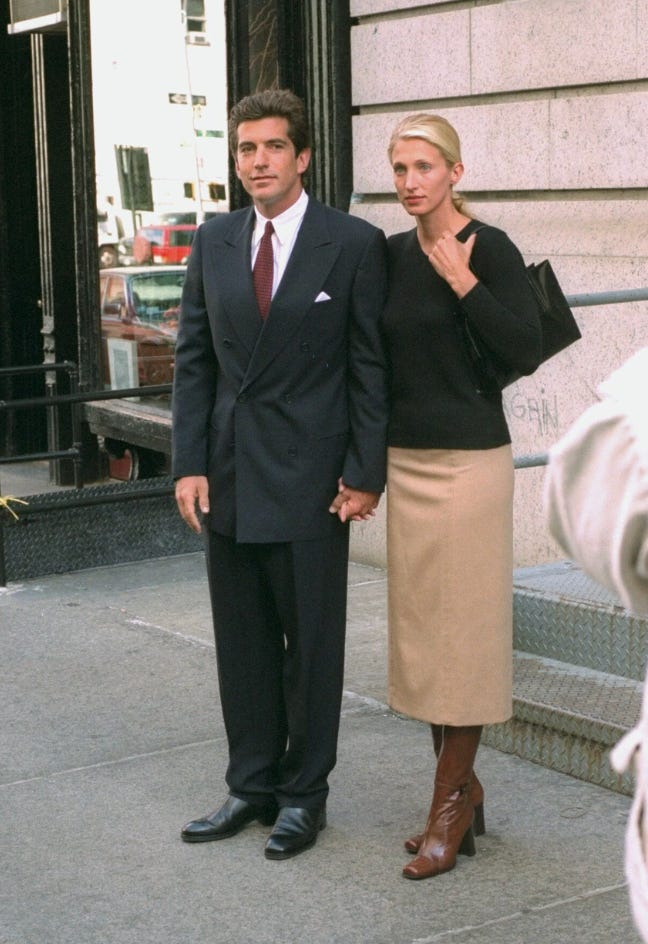
She stopped wearing jewelry after the marriage, not wanting to draw attention to her hands, neck, or ears. The softer silhouettes and light bohemian influence morphed into a near-total black palette, sharper silhouettes with tighter frames. She wore almost exclusively Prada, which was significant to me to learn, as Prada in the mid-1990s was not the status symbol it is now. Prada’s aesthetic under Miuccia Prada was specifically, deliberately anti-glamour, the kind of woman that does not do frills or lace, sharp and intellectual in a way that fashion at the time mostly wasn’t. When she reached for Prada, she was reaching for control. What we idolize and obsess over is the outfit of who she was forced to be, not who she naturally was.
The irony of labeling her the queen of effortless elegance is nearly as brutal as it is total.
On February 25th 1996, a photographer crept into the background of Washington Square Park and filmed the argument that changed America’s perception of Carolyn forever. She was allegedly furious because her fiancé was being manipulated: John had been asked to be the best man for a man who was barely an acquaintance, supposedly orchestrated by the bride-to-be who placed John next to the New York Times society editor for the evening. The footage shows them screaming, John removing her engagement ring from her finger, Carolyn lunging on him from behind, John sitting on a curb, and their dog Friday, who had nowhere to go. The National Enquirer bought the photographs and ran an eight-page spread in the Daily News. CBS bought the video and broadcast it over five consecutive days beginning March 11, 1996. Within weeks, Carolyn left Calvin Klein.
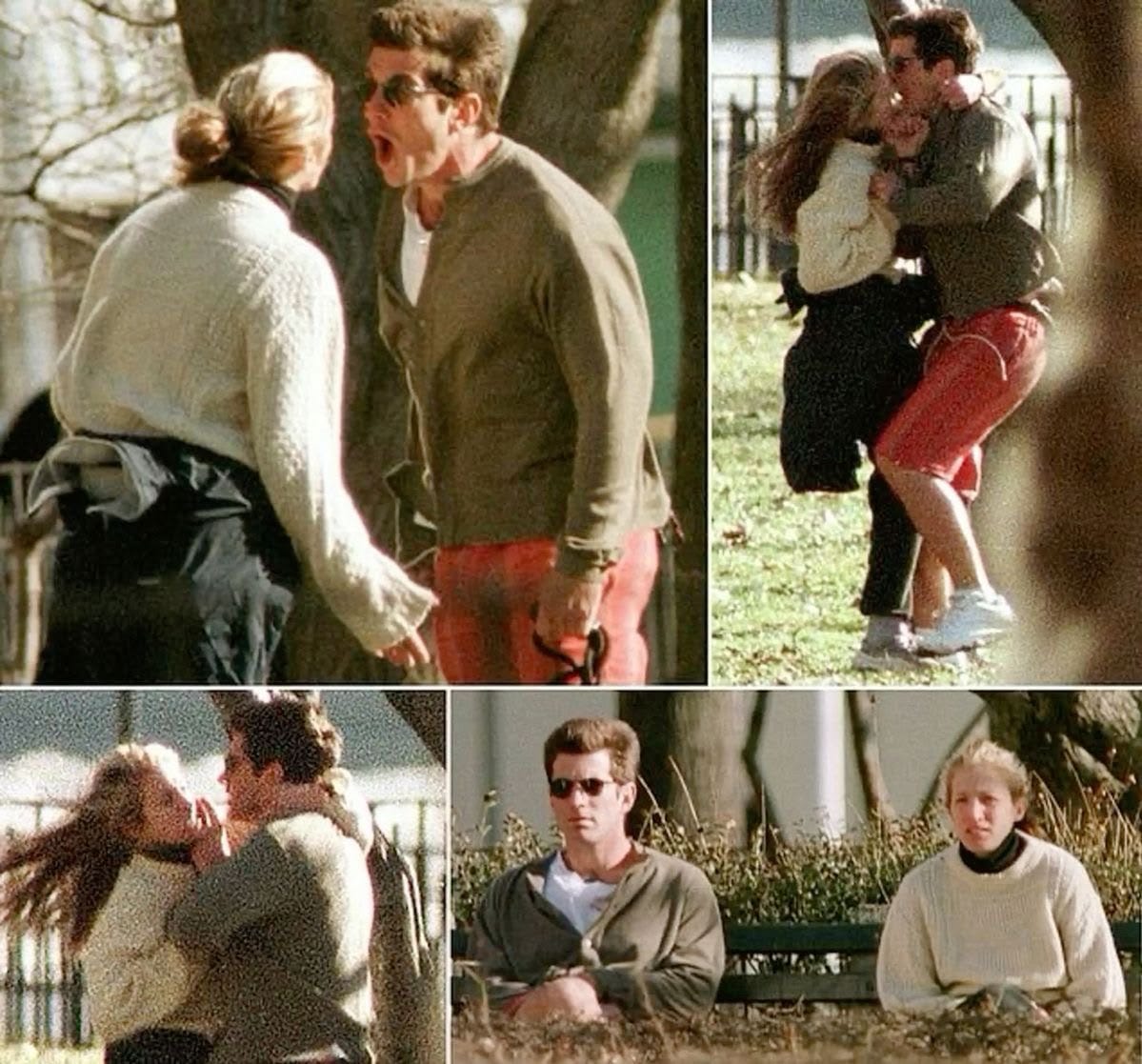
After the park footage ran, Ethel Kennedy, the matriarch of the Kennedy family, told Carolyn at twenty-nine years old that she would never be given the benefit of the doubt again. Despite her repeated pleas for privacy, the press did everything in their power to eat her alive. She was called the ice queen, ungrateful shrew, thin enough to be a drug addict, not good enough for her husband, her style dismissed by W Magazine and Vanity Fair as throwaway chic. Carolyn understood that how people saw her wasn’t going to change, and the way she started dressing is proof of it. She used style as a way to manage a kind of attention she never asked for and could not escape.
“She was panic-stricken by the whole thing — all that fame and attention, with all these cameras in her face. Can you imagine what it was like for her to lose her old life — a life where she was free?”
Sasha Chermayeff, close friend
The Proxy is someone whose style has been shaped by the room she is in rather than the person she is. Her identity is still there, still alive, but it comes through in fragments, in the small choices she makes within the boundaries of what the situation allows. She looks composed. She looks intentional. From the outside it reads as self-possession. From the inside it is management.
She found the degree of latitude she could work within and microdosed her personality in a well-managed wardrobe.
THE GHOST
Abdicated Style x Suppressed Identity
The Heir and the Ghost can look identical from the outside, both apparently unbothered, both seemingly effortless. The Heir dresses without thinking because nothing needs to be proven. The Ghost dresses without thinking because there is no more energy left to spend.
By 1998, her world had physically contracted. She left her apartment before 7am to avoid the paparazzi, and she hadn’t worked in two years. The tabloids that called her ice queen, gold digger, and coke head hadn’t relented, engorged by the fact that the couple was in marriage counseling. Anthony Radziwill, John’s closest friend, was dying of cancer. They were, to put it bluntly, the worst of times. Carolyn's wardrobe during this time was significantly less documented, but in the photographs from her last public appearances she still looked composed, though not as carefree as she once was. This is what makes the Ghost position so difficult to see in real time, and so obvious in retrospect. Her ability to look so poised when she felt so disconnected is a marvelous show of control. Chermayeff said it plainly years later: "Even her closest friends and husband sometimes couldn't see it for what it was. Everyone thought, come on, figure this out. Only in hindsight I see that no one was really fully there for her in that way."
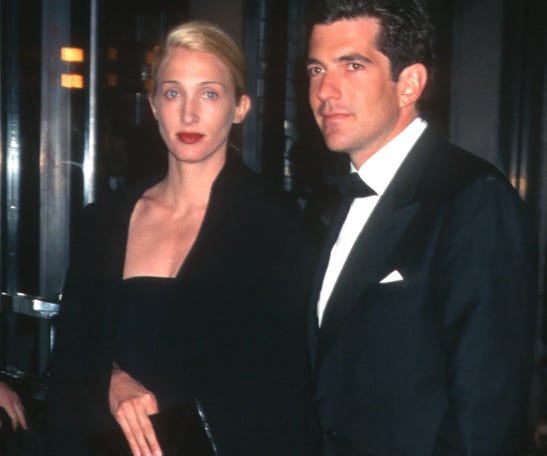
On July 16th 1999, John, Carolyn and her sister Lauren departed Essex County Airport in New Jersey at 8:38pm, thirteen minutes after sunset. Approximately an hour after takeoff, over open water in the dark, John experienced spatial disorientation, a condition in which a pilot loses his reference to the horizon. Suffering an uncontrolled spiral, the plane crashed into the water below. Within 30 seconds, all three passengers died on impact.
Five days later and 120 feet below the surface, the bodies of Lauren Bessette, John F. Kennedy Jr., and Carolyn Bessette-Kennedy were discovered, still strapped in their seats. At only 33 years old, the same publication that labeled her throwaway chic declared in her obituary that she was “arguably the only true successor to Jackie’s legacy.”
The woman they treated like an animal at the zoo became the woman they spent the next twenty-five years worshipping, and the wardrobe they photographed without her consent became the wardrobe that sold for $180,000 at Sotheby’s. The minimalism they called throwaway has become the golden child of the 2026 algorithm, and what keeps me awake at night is the idea that if she was still alive, we might not give a shit.
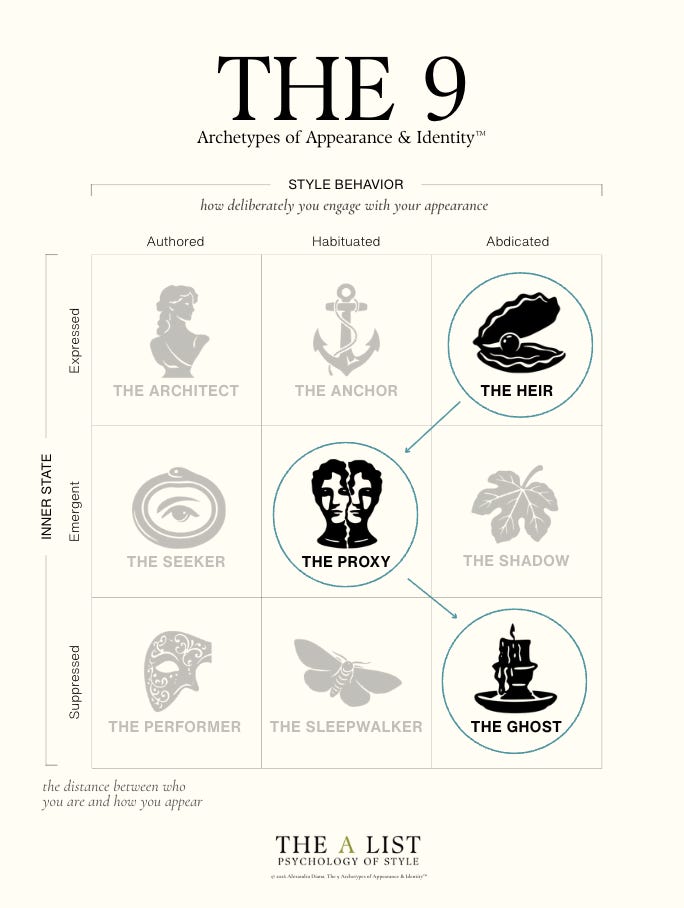
Heir → Proxy → Ghost
The woman who wore blue nail polish →
The woman who wore what a Kennedy wife should →
The woman who gave the cameras the minimum to keep the rest for herself.
Carolyn Bessette-Kennedy's life proves that your style is a self-fulfilling prophecy, because the clothes she wore when she had the least freedom became the most copied aesthetic of the century. She wasn't writing the prophecy. Someone else was writing it for her, and she was wearing the evidence of it every single day.
What would you wear, if everyone hated you?
I think about this a lot, almost as much as I think about how Carolyn would hate this piece. She gave no interviews, made no statements. She constructed, in one of the most hostile conditions imaginable, an image to protect herself that we have perversely and inversely swallowed whole.
What’s funny to me now is that I used to be so annoyed by the saturation of content around her, the same 50 photos circulating with the same backwashed minimalistic quiet luxury effortless fashion old money-core-fattened captions. Now I look at her, and I wonder what music she listened to, if she liked Jerry Seinfeld, if she would tell me the shade of that blue nail polish she used to wear. I wonder if she knew that most people credit her for Calvin Klein signing Kate Moss, or that Ralph Lauren told his design team to think of her when they imagined future collections. I wonder if her style would have become more like Diana’s or Jackie’s, or if it would have evolved into something we’d never seen before.
What I do know is that she never posed for the paparazzi, wore the same jeans on repeat and wore the same shade of red lipstick her entire life.
The very least we could do is know who we're copying.
With great personal aesthetic,
Alexandra Diana, The A List
This is the first piece about CBK that I've actually read. Nicely done.