


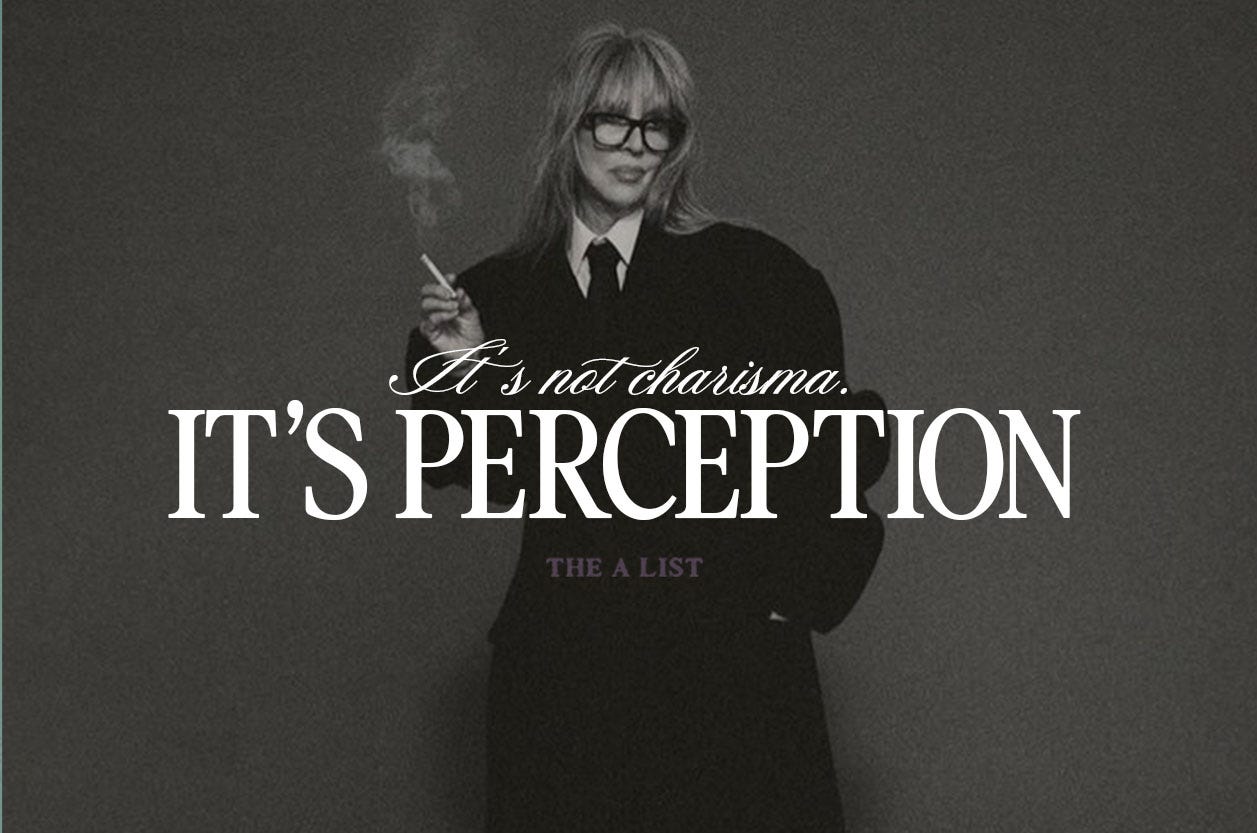
Most people believe confidence comes from what they wear.
In reality, authority is granted only after confidence is perceived.
In the first three seconds, the brain makes its decision using only three inputs: shape, color, and detail. These elements determine who is perceived as dominant, readable, or invisible, no matter who you are; no matter what room you find yourself in.
I once heard this described perfectly: “Dress like you mean it.” What she was naming wasn’t intention. It was alignment.
These are the aesthetic mechanisms everyone is judging you against…whether you realize it or not.

HOW SILHOUETTE SHAPES YOUR PRESENCE
Before your face is registered, your body is classified.
Silhouette is processed in milliseconds as a power cue. The brain does not see “clothing” first, it sees outline. Size, edge, and spatial intention are assessed immediately: How much space the body claims, whether its edges are sharp or softened, if the form appears deliberate or defensive. These signals subconsciously sort a person into categories long before conscious thought occurs.
Grace Jones


Jones uses angular, high-volume silhouettes that deliberately expand and heighten her frame. The sharpness and scale of her outline instantly makes her appear decisive, in-control. Standing, speaking or sitting, her presence is read as high-power because her silhouette conveys a person of authority.
Princess Diana


Diana demonstrated precise control over her silhouette, especially as her context shifted. In public, casual settings, she softened her outline, oversized sweatshirts, relaxed proportions, signaling physical ease and approachability while retaining strength. In formal contexts, she returned to crisp, structured silhouettes that anchored authority. The shift was not emotional. It was strategic. Her silhouette changed how she was read before she was heard.
Mr. Rogers


Rogers maintained a comforting, rounded silhouette: soft cardigans, relaxed shoulders, no sharpened angles or volume. His outline minimized dominance cues and consistently communicated safety, steadiness, and emotional reliability. Over time, this silhouette became shorthand: His body itself signaled trust.
HOW COLOR SIGNALS CONFIDENCE
Color is processed as emotional information before it is processed as aesthetics.
The brain uses saturation, contrast, and palette consistency to predict emotional intensity and confidence. Highly saturated colors raise arousal and signal assertiveness. Muted or low-contrast palettes signal calm or restraint. Consistent palettes signal stability. You feel the color before you interpret it.
Color conditions what we think about others, long before we recognize it as a decoration.
Grace Jones


Jones uses high-contrast palettes: Deep blacks, metallics, electric reds, that heighten visual arousal and psychological distance. The intensity of her color choices reinforces authority by limiting access. She is seen as commanding, predominant, important. Her palette signals that engagement happens on her terms.
Princess Diana


Diana frequently used soft blues, pastels, and low-saturation hues. These colors reduced visual threat while maintaining composure, as they made her incredibly approachable without diminishing her presence. The result was that she felt warm, caring, kind, someone we automatically feel affection for and see as honest.
Mr. Rogers


Rogers relied on a warm, highly consistent palette of reds and neutrals. Worn the same way, in the same context, red stopped functioning as a signal that demanded attention. It became familiar, anchoring, and quietly reassuring. The repetition was crucial. Predictable color became a regulatory signal: Emotionally stabilizing, familiar, and trustworthy.
HOW DETAIL CHANGES HOW YOU’RE SEEN
Detail does not add interest. It changes interpretation.
The brain interprets simplicity as control and complexity as stimulation.
Low-detail presentation reads as composure. High-detail presentation reads as energy, unpredictability, or intensity. Therefore, your ability to create consistency in your level of detail becomes a trust signal.
Grace Jones


Jones frequently uses high-detail elements, metallic textures, sharp contrasts, layered finishes, that increase perceptual stimulation. The visual density amplifies her presence and reinforces intensity. The complexity is not accidental. It sustains her psychological charge.
Princess Diana


Diana modulated detail precisely. In formal contexts, she incorporated embellishment, pattern, or layered texture to match the gravity of the environment. In casual settings, she stripped detail back to clean lines and minimal elements. The coherence between context and detail preserved credibility.
Mr. Rogers


Rogers maintained extremely low visual detail: solid colors, simple textures, no pattern variation. This minimized cognitive load and reinforced psychological safety. His consistency became authority through predictability. Nothing competed for attention. Nothing needed to.
WHY THIS MATTERS
Confidence is not something you feel and then express. It is something you signal, and then experience reflected back to you.
Confidence cannot be projected through force. It’s established through visual structure, palette clarity, and perceptual coherence. When these elements align, the room responds before you act.
That’s not psychology as motivation; it’s perception as mechanism.
And once you see it, you won’t be able to miss it.
With great personal aesthetic,
Alexandra Diana, The A List
The 9 People You’ll Meet in Your Closet

Your wardrobe is a modern-day psychological thriller. Each morning you wake up to solve the same mystery: Why don’t I look like myself?
I AM OBSESSED WITH YOUR VOICE
Wow, you blew my mind (as always)! The people you chose as examples were absolutely perfect! I especially love the inclusion of Mr. Rogers.
It’s funny how I wouldn’t think of him when I hear the word “confidence”. Maybe it’s because I’ve worked in tech too long, but my definition of confidence shifted over the years. I typically think that the loudest person in the room making their opinions known to anyone in earshot is the “confident” one. But soft confidence holds so much power.
Loud doesn’t equal confidence. Quiet authority might be the way forward.